



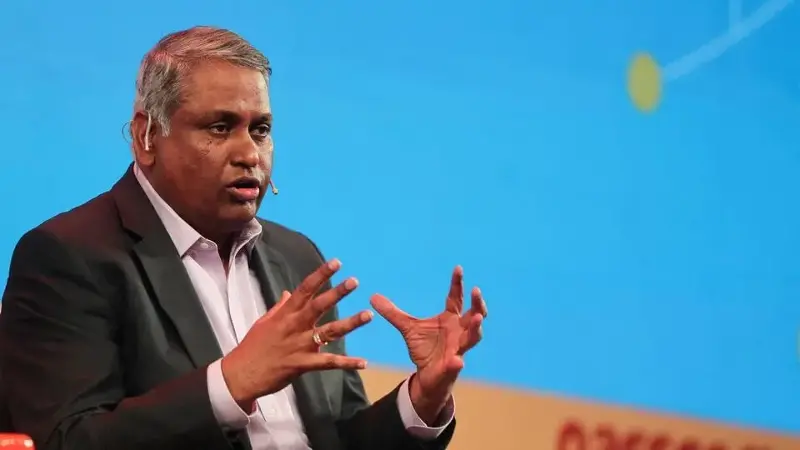
As artificial intelligence (AI) stirs fresh doubts about the future of information technology services, HCL Technologies Ltd’s chief executive officer C. Vijayakumar said the industry is indeed at its biggest inflection point yet, and it faces a painful, people-led transition. He, however, pushed back against fears of sweeping disruption, arguing that enterprise adoption will take time and is “not as dramatic” as being portrayed.
“So I think I would say this: this transition is different… it's going to be painful because it really involves people,” said Vijayakumar during a fireside chat at the Nasscom Technology and Leadership Forum 2026 in Mumbai on Tuesday.
The chief executive's comments come as worries around the relevance of IT services have pulled down the company’s shares by more than 17% since the start of the year. On the other hand, the industry's Nifty IT index fell more than 20% during this time.
Amid a fresh wave of shareholder concern around IT services, the company’s shares fell 6.1% on Tuesday. Much of this came after AI major Anthropic’s latest blog post on 23 February that suggested AI could modernize software that manages automated teller machines (ATMs) run by banks. Shares of the country’s largest IT services companies were down 2-7%, with HCL being the worst hit among the top four.
Vijayakumar, one of Indian IT’s longest-serving CEOs, dismissed these concerns. “Technology is definitely becoming much more powerful, but what is being missed is how do you really deploy it in an enterprise," he said. "Today, there is a big lag between how fast technology is evolving and how it is getting deployed in the enterprise. I think that’s where the challenges are going to be,” Vijayakumar said in a media interaction after the fireside chat.
“It’s going to take time; it is not as dramatic as what is being portrayed that technology can achieve,” said Vijayakumar, who will complete a decade as the company’s chief executive in October 2026.
The chief executive also sought to calm nerves of millions of engineering graduates eyeing jobs at India's top tech service firms by adding that core software engineering jobs would always be in demand.
“The demand for specialized skills, I think will grow significantly, whether it is data, cloud, security, AI… all these specialized skills will be in a lot more demand,” he said. "I also think the core software engineering concepts will be very, very relevant," Vijayakumar added.
The company ended last year with $13.84 billion in revenue, up 4.3%. This makes it the fastest growing IT services company among the country’s big five for the last two years. The management expects the company to outgrow its peers for the third straight year, as companies further unlock spending on non-essential technology.
In revenue terms, HCLTech ranks third among India's IT service providers after Tata Consultancy Services and Infosys. Wipro and Tech Mahindra follow. TCS, Infosys, Wipro and Tech Mahindra reported an annual revenue of $30.18 billion, $19.28 billion, $10.51 billion, and $6.26 billion, respectively. TCS and Infosys's revenues were up 3.8% and 3.8%, whereas Wipro and Tech Mahindra saw a 2.7% and 0.2% decline, respectively.
HCLTech was also the first of the big five IT firms to share details on revenue from GenAI, when it disclosed the numbers in October last year. It reported about $246 million revenue from advanced projects, including agentic AI, AI factories and physical AI for the July-December 2025 period.
Vijayakumar’s opinions are similar to those of company chairperson Roshni Nadar-Malhotra three days ago. She said the industry had taken to technological cycles in the past and that “this is not the first time that we’ve been here.”
“The industry has adapted to many technological cycles over many decades. For us, AI is going to be a force multiplier. It’s a good thing, because companies will always need software services. AI is like blocks of Lego, and you’re not just going to make sense of it without having someone tell you what to make of it,” Nadar-Malhotra said at a media roundtable on the sidelines of the group’s first semiconductor project inauguration in Jewar, Uttar Pradesh.
Chips on board
Vijayakumar said that semiconductor companies and tech hardware manufacturers stand to benefit the most from the AI wave. “I think the value is disproportionately with semiconductor companies. Enormous value is captured by the tech OEMs and the semiconductor companies. That's because it's truly driven by a constraint that exists, and whether it is semiconductors or even technology, I don't think there will be more competitive players emerge…” he said.
Unlike its bigger rival TCS, which is looking to build and maintain data centres, HCLTech is venturing into its hardware roots as its parent HCL Corp, flagship of the HCL Group, plans to supply chips for a quarter of India’s displays by the next two years.
The HCL Group, founded by billionaire Shiv Nadar, will run the semiconductor plant with Taiwan-headquartered global contract manufacturer Foxconn, as a privately held joint venture, India Chip Pvt Ltd. HCL Corp holds a 60% stake in the joint venture, with Foxconn holding the remaining 40%.
While the semiconductor wing might work independent of HCLTech, the company is not new to chips. HCLTech was earlier engaged in the engineering, research and development of semiconductor chips.