



AI adoption has become synonymous with working faster and growing profits for a majority of businesses. But, some organisations are asking a different question: Can AI also help people who are often left behind, and can that impact be measured?
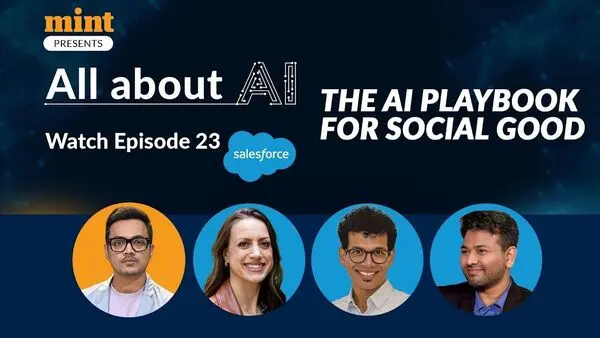
That was the focus of the latest episode of Mint’s All About AI, hosted by Abhishek Singh, Associate Editor, LiveMint. The panel brought together Sunya Norman, SVP, Impact at Salesforce, Ram Kolavennu, CEO of Foundation for Excellence and Shashanka Kundu, Director of Product at Udhyam Learning Foundation.
The discussion came as a curtain raiser for the third edition of the Mint All About AI Tech4Good Awards, sponsored by Salesforce. Scheduled for November 13th in Mumbai, the awards night will celebrate organisations that use AI to create measurable impact in areas such as sustainability, accessibility, financial inclusion and education. Find out more about the awards here.
Giving non-profits the same tools as big companies
Norman said trust sits at the centre of Salesforce’s AI work, alongside ethics, data protection and sustainability. The company also runs a ‘1-1-1 model’ that commits 1% of its equity, 1% of employee time and 1% of its product to charitable causes. It began 27 years ago, on the company’s first day.
“You can’t leave non-profits behind. They deserve the tools that Fortune 500 companies use every day,” Norman said. She also spoke about promising uses in India, such as helping farmers with weather and crop data.
From scholarship to first job in one generation
Foundation for Excellence helps students who are academically strong but from low-income families to study disciplines like engineering, medicine and law. To qualify for the scholarships, meritorious children must come from families that earn less than ₹3 lakh a year. Last year, it supported more than 22,000 students, picked from about 44,000 applications. Most of them were from rural and semi-urban homes, and many are first-generation college students.
Kolavennu said 93% of last year’s engineering graduates found work soon after finishing, with an average salary of about ₹11 lakh. Their family income when they joined was around ₹1-1.2 lakh. “The idea is to bring in a transformation in a single generation,” he said.
He said students often lack information and networks. “They don’t know what they don’t know,” he said, adding that AI could help close those gaps. The foundation works with about 130 corporate partners to teach AI skills while students are still in college.
What a pilot taught one learning charity
Kundu, whose organisation was recognised at last year’s awards, said its AI tools reached about 3.5 lakh students last year. That number has roughly doubled this year, with states such as Punjab and Haryana adding more students.
Not everything worked at first. Udhyam’s first AI mentor, a WhatsApp chatbot, was tested with about 10,000 students in Punjab and Delhi. “We expected it to be revolutionary, but only the highly motivated students would actually end up asking relevant questions,” Kundu said.
The fix was to build the mentor into the learning journey itself. Students now submit project work through the chatbot and get feedback and next steps. About 10% of teams resubmitted improved work after that feedback.
Good AI starts with good data
Norman shared a lesson from business that applies to social causes too. “Your AI is only as good as your data is,” she said. A language model alone cannot understand an organisation’s context, she explained. It must be grounded in the right information, such as student records and workforce data.
She also cautioned that not every problem needs AI. Sometimes, a simple database call works better.
Listening to the people AI is meant to serve
Asked how underserved communities can shape the technology, the panelists spoke about feedback loops. Norman said Salesforce takes input from customers, community groups and an advisory council on ethical and humane use that includes researchers, NGOs and government.
Kundu said Udhyam lets teachers and students report problems, and is now training a model on past challenges to give teachers instant suggestions. “This becomes very crucial for us to build tech which adapts to the human experience rather than humans adapting to technology,” he said.
Trust and reach
In a rapid-fire round, Kundu chose high-quality, personalised mentorship for all as the problem he would want AI to solve overnight. Kolavennu picked deeper access in every part of the country, and Norman picked getting useful information to more people, faster.
Asked when AI will have truly changed the world for the better, the panel gave similar answers: when it is trusted and when it reaches everyone. “It’s truly trusted,” Norman said.