



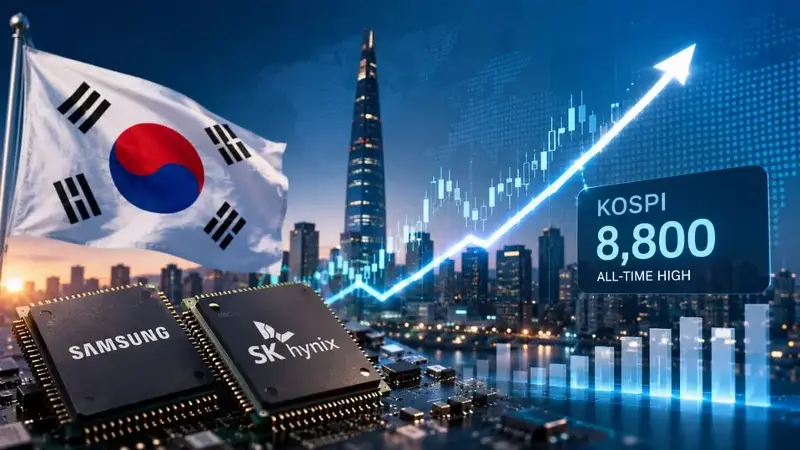
South Korea's stock market is experiencing a historic rally and has recently surpassed India to become the sixth-largest stock market in the world. The rise of South Korea's Kospi index to a record high has largely been attributed to the rising demand for AI chips and two local chipmakers that have gone on to become some of the world's most valuable companies.
How did AI chipmakers lead to a ‘historic surge’ in South Korea's market?
Chipmaker SK Hynix joined the trillion-dollar valuation club last week, alongside Samsung Electronics and Taiwan Semiconductor Manufacturing Company (TSMC) as the only Asian companies to reach the landmark.
According to a report by The Guardian, SK Hynix's share price has surged byaround 1,000% over the past year, while Samsung's stock has climbed roughly 500%. The growth of the two chipmakers has led to a massive uptick in South Korea's stock market since late 2025, with the Kospi Index reaching an all-time high of 8,800 this week, marking a 220% riseover the last 12 months.
Meanwhile, investment bank Goldman Sachs has also issued a bullish market prediction, raising its 12-month Kospi target to 9,000 and calling the current environment a "once-in-a-generation surge" in semiconductor earnings.
‘Dramatic shift’ underway in South Korea:
Peter Kim, global investment strategist at KB Securities, told The Guardian that there is a ‘dramatic shift’ underway, with capital now shifting from software giants like Alphabet, Amazon, and Meta to semiconductor companies that provide the infrastructure needed to train and run AI models.
He notes that chipmakers had limited investment appeal until recently, but the rise of AI has led to an ‘amazing reversion’.
Notably, the growing popularity of generative AI tools like ChatGPT, Gemini, and Claude has driven unprecedented demand for advanced processors and memory chips, placing Korean chipmakers at the centre of the AI supply chain.
At the centre of it all is Nvidia, the world's most valuable company. While Nvidia designs the AI accelerators used by major AI firms, the chips are manufactured by TSMC, which, coincidentally, became the first company in Asia to reach $1 trillion.
Meanwhile, high-bandwidth memory chips are supplied by Samsung, SK Hynix, and US-based Micron.
NVIDIA CEO Jensen Huang was recently in Taiwan as he unveiled the company's latest RTX Spark chip for Windows PCs. Reportedly, he also met with top South Korean tech executives while in Taiwan and is also set to fly to South Korea this week.
How could South Korea be too dependent on just two companies?
The two companies in question, Samsung Electronics and SK Hynix, have seen very high growth as the rise of advanced AI models and data centres has driven unprecedented demand for processors and memory chips.
However, the Guardian report also suggests that South Korea could be overly dependent on its two trillion-dollar companies. The report notes that Samsung and SK Hynix are responsible for as much as 70% of Kospi's gains in 2026, leaving the index exposed to the global AI spending cycle and supply chain issues.
Russ Mould, investment director at AJ Bell, told The Guardian that the share price charts of Samsung, SK Hynix, and Micron bear some similarities to technology stocks during the 2000 dot-com era. However, Mould argues that the boom-and-bust cycles of the chip sector are behind us “thanks to demand from AI”.