



Few daily routines offer as much developmental value as sharing a book with a child. Storytime may look simple: an adult, a child, and a few illustrated pages. Yet beneath this cozy moment lies a powerful workout for a growing brain.
Early reading supports language, memory, attention, emotional understanding, and the core social skills children need to form strong relationships. The benefits begin long before a child can read independently:
- Babies absorb the rhythm of a familiar voice.
- Toddlers acquire new vocabulary through repetition.
- Preschoolers connect sounds, letters, pictures, and meaning.
Whether it happens before bed, after lunch, or during a quiet commute, storytime turns ordinary minutes into meaningful learning.
A Larger Vocabulary Starts with Shared Books
Children’s books often feature rich words that rarely appear in casual conversation. A story about a bear’s enormous appetite, a character who feels frustrated, or a journey through a mysterious forest gives children access to advanced language.
Reading aloud introduces vocabulary in context. When a child sees an illustration of someone clutching a broken toy while hearing, "She was disappointed," the emotion and the word instantly connect.
Caregivers can enhance this naturally by engaging in brief exchanges:
- Ask open questions like, "What do you think 'disappointed' means?"
- Relate the story to real life: "Have you ever felt that way?"
- Keep the conversation relaxed rather than turning it into a formal test.
Stories Strengthen Attention and Memory
Following a plot requires a child to remember earlier events, notice visual clues, and predict what happens next—building essential working memory and sustained attention.
Re-reading favorite books is especially valuable:
- Noticing details: Each reading reveals fresh nuances in the illustrations.
- Anticipating plots: Children learn to predict a character's next action.
- Building confidence: Reciting parts of a book from memory helps children grasp story structure.
Asking simple questions such as, "What happened before the rabbit found the key?" encourages young minds to organize information sequentially.

Reading Builds Emotional Intelligence
Books provide a safe space to explore big feelings like jealousy, nervousness, or sadness. Watching fictional characters navigate these experiences helps children realize that complex emotions are normal and manageable.
This process nurtures empathy and perspective-taking. Many children's stories use humor, gentle adventure, and friendly animal characters to explore emotional topics without making a child feel exposed or overwhelmed.
The Brain Learns Through Interaction
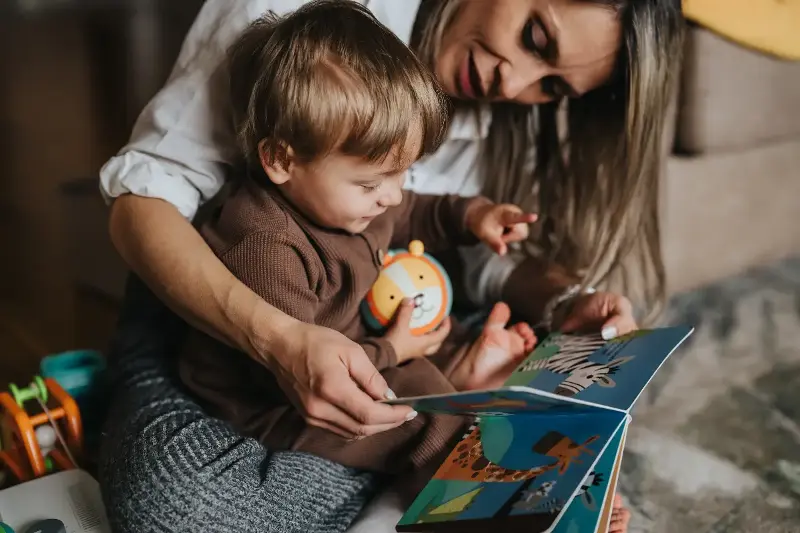
The true strength of storytime lies in shared reading—the interactive back-and-forth between child and adult.
Children learn best when they are active participants:
- Turning the pages independently
- Choosing the book for the session
- Pointing to pictures and copying animal sounds
- Asking questions and retelling parts of the plot
The physical closeness, undivided attention, and warmth of a calm voice create positive associations that foster a lifelong love for books.
Early Literacy Beyond the Alphabet
Before children learn to decode text, they develop print awareness—understanding that marks on a page carry meaning. They learn how books function and how spoken words translate to written symbols.
- Rhyming stories help children hear smaller sounds within words, strengthening phonological awareness.
- Playful repetition prepares children to recognize sound patterns.
- Narrative skills develop as children learn that stories have characters, settings, problems, and resolutions.
Making Storytime Work in Real Life
A successful reading routine does not require an hour of free time; ten focused minutes can make a profound impact.
Let your child’s interests guide the way, whether they love trucks, dinosaurs, fairy tales, or silly poems. Graphic books, wordless picture books, and nonfiction all support growth. Every shared story sends a quiet message: words matter, ideas are exciting, and reading is a place where you belong.