



If you have ever strolled through a carnival and caught the scent of sugary air, you have savored one of life’s simplest joys: cotton candy. That wispy, pastel treat is true magic, transforming humble sugar crystals into ethereal puffs that melt instantly on your tongue. Beyond its sweet charm lies a fascinating history—a blend of innovation, accidental invention, and clever physics that continues to spin delight around the world.
A WHIRLWIND OF SWEET BEGINNINGS
Long before the vibrant, neon colors seen at modern fairs, the roots of this treat trace back to an era when sugar was a rare luxury. Ancient civilizations, including the Egyptians and Greeks, crafted early forms of spun sugar by hand, pulling molten sugar into delicate strands. However, this process was painstaking and reserved exclusively for royalty.
The real revolution began in 1897 in Nashville, Tennessee. An unlikely pair—dentist William Morrison and confectioner John C. Wharton—invented the first electric machine capable of spinning sugar into fine threads. Ironically, while Morrison’s profession focused on dental health, his invention helped unleash a global phenomenon. By the 1904 World’s Fair, the pair sold over 68,000 servings of their “fairy floss,” cementing the treat's place in history.

FROM FAIRY FLOSS TO COTTON CANDY
Originally branded as “fairy floss” due to its gossamer texture, the treat’s name evolved over time. In Australia and New Zealand, you will still find it sold under the classic name "fairy floss." It wasn’t until the 1920s, after a New Orleans dentist named Joseph Lascaux patented a similar machine, that the term "cotton candy" became the standard in the United States.
As technology advanced, machines became faster and more stable, making this sugary cloud an affordable staple at circuses, theme parks, and local festivals for generations to enjoy.

SPINNING THE SCIENCE: HOW IT WORKS
While it may seem like pure magic, creating cotton candy is a marvel of physics and engineering.
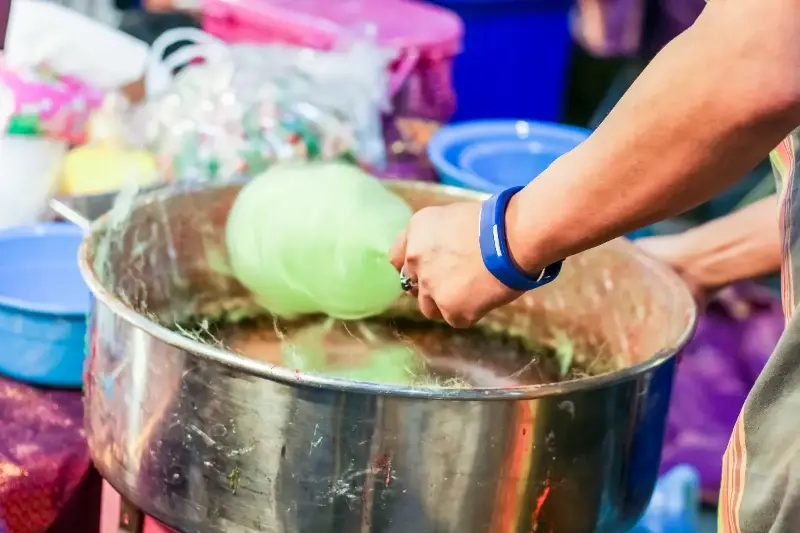
- The Process: Granulated sugar is poured into a spinning center cylinder featuring tiny holes.
- The Transformation: As the cylinder heats and spins at roughly 3,600 revolutions per minute, centrifugal force flings the melted sugar through the holes, creating ultra-thin strands.
- The Solidification: As these strands hit the cooler air, they instantly re-solidify into a web-like structure.
- The Result: A skilled operator collects these filaments onto a paper cone, creating the iconic fluffy ball.
Remarkably, each filament is about 1/50th the thickness of a human hair. Because the web is mostly air, a standard serving contains surprisingly little sugar—often less than a single tablespoon!
COLORS, FLAVORS, AND GLOBAL TWISTS
While classic pastel pink and blue remain favorites, today’s cotton candy comes in a dazzling array of hues and flavors, from zesty green apple to bubblegum. Across the globe, cultures have added their own unique spin:
- Pismaniye (Turkey & Iran): A denser, silkier version made by pulling flour and sugar together.
- Buddi ka baal (India): Translated as “old lady’s hair”, this local favorite celebrates the treat’s delicate, wispy texture.

BEYOND THE CARNIVAL: MODERN MARVELS
Cotton candy is more than just a snack; it is a cultural icon. It evokes nostalgia and childhood wonder, and today, chefs even use it to create dramatic dessert presentations in fine dining.
Perhaps most surprisingly, the technology behind the cotton candy machine has found its way into advanced medical research. Scientists are using the machine’s spinning mechanics to create artificial blood vessels and scaffolds for tissue engineering. This humble treat continues to prove that it can do more than just delight—it can help heal. Whether you call it fairy floss or cotton candy, you are enjoying a bite-sized piece of history, spun with science and pure joy.