


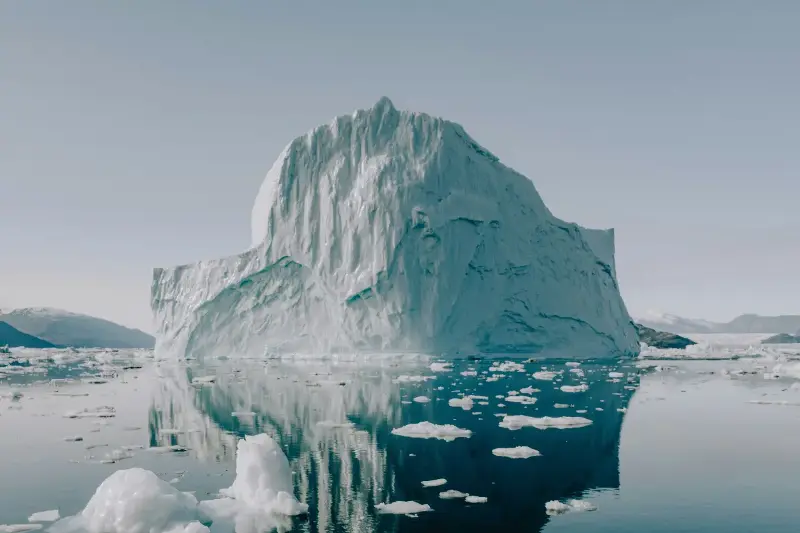
Antarctic icebergs begin their lives far inland, where snow falls year after year and slowly compresses into glacier ice. Over centuries, the weight of newer snow squeezes out air pockets, turning soft drifts into dense, blue-white ice. This ice flows downhill under its own enormous weight, moving from the high Antarctic plateau toward the coast at speeds ranging from a few meters to several kilometers annually.
The journey is slow, but the scale is extraordinary. Antarctica holds about 90 percent of the world’s glacier ice and roughly 70 percent of its fresh water. Much of that ice eventually reaches the ocean through vast floating extensions called ice shelves. These shelves can be hundreds of meters thick and spread across areas larger than entire nations.
Born at the Ice Shelf
An iceberg is created through a natural process called calving. As glacier ice pushes outward across the coast and becomes a floating ice shelf, cracks develop under stresses caused by:
- Tides and ocean currents shifting beneath the ice.
- Surface melting and seasonal temperature variations.
- Forward movement driving the glacier toward open water.
Eventually, a fracture widens enough for a block of ice to break away completely. While some icebergs are relatively small—perhaps the size of a house—others are absolute giants. Tabular icebergs, named for their flat tops and steep sides, can measure tens of kilometers across. Calving is a natural part of the polar ice cycle, providing vital data for scientists monitoring shifting ocean patterns and global ice balance.
A Floating Mountain of Fresh Water
Although an iceberg may rise dramatically above the waves, about 90 percent of its volume lies hidden below the surface. A berg that appears to stand 30 meters above the water may extend roughly 270 meters downward into the ocean depths.
Key features of this submerged mass include:
- Underwater keels: Massive hidden bases that can scrape the seafloor in shallow regions, leaving long grooves known as iceberg plow marks.
- Geological records: Plow marks offer valuable clues about past ocean conditions over thousands of years.
- Freshwater release: As pure, frozen snow melts into the salty Southern Ocean, it releases essential minerals, fine sediments, and nutrient particles collected during its journey across land.
Carried by Wind and Currents
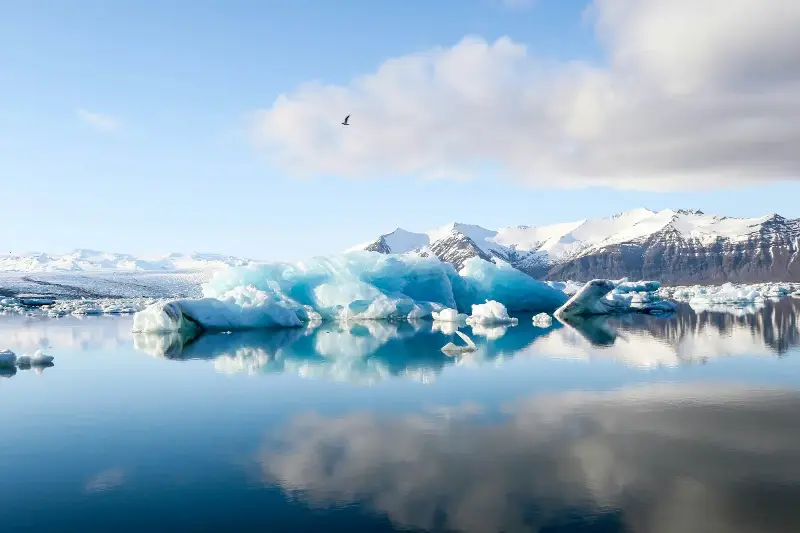
Once free, an iceberg becomes a passenger of the Southern Ocean, guided by winds, waves, sea ice, and powerful currents. Many icebergs drift westward around Antarctica with the Antarctic Coastal Current before entering broader oceanic circulation.
Scientists track these drifting masses using satellite radar, which can observe icebergs through heavy clouds and during the long polar night. Tracking helps protect shipping routes while measuring how fresh water enters the marine environment. As an iceberg moves into warmer waters, its edges begin to crumble, carving deep blue pools, sea caves, and striking pinnacles into the ice.
Melting from Every Direction
Icebergs melt both above and below the waterline. Sunlight and warm air soften the exposed surface, while seawater eats away at the submerged base. Waves continuously strike the sides, breaking off smaller pieces:
- Bergy bits: Medium-sized floating chunks of ice.
- Growlers: Low-floating, dense ice fragments that can be difficult to spot on the water's surface.
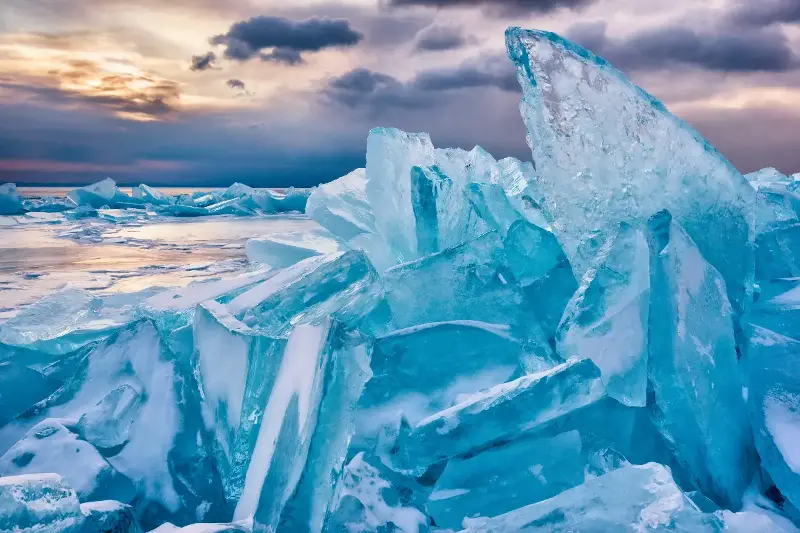
As melting alters an iceberg's weight distribution, the berg can become unstable and roll over suddenly. This dramatic event exposes deep interior ice that looks intensely blue, as dense glacier ice absorbs red light and reflects brilliant blue wavelengths.
Furthermore, melting icebergs create vibrant, temporary ecosystems. Their freshwater plumes bring rich nutrients toward the surface, allowing phytoplankton to flourish, which in turn supports fish, seabirds, and marine life.
The Final Return to the Sea
Eventually, every iceberg completes its life cycle. In warmer waters, the remaining ice fractures into smaller pieces and melts completely. Its fresh water becomes part of the global ocean, mixing with marine currents that travel around the globe, while carried sediments settle onto the seafloor.
An iceberg's floating journey may last days, months, or years, serving as a vital link in the Antarctic cycle. Snow falls on the continent, becomes glacier ice, flows to the coast, breaks into the sea, and finally returns to the ocean. Each drifting iceberg stands as a striking symbol of the polar world and a moving record of Earth’s dynamic water systems.