



When you slip behind the wheel and turn the key, you expect your car to start without a second thought. What many drivers do not realize is that there is a complex orchestra of electrical components working in harmony under the hood. Knowing how your car’s electrical system works is essential for keeping your ride running reliably and safely.
UNDERSTANDING THE HEART OF THE SYSTEM: THE BATTERY
Every vehicle's electrical life begins directly with the battery. It acts as the primary reservoir of energy, sending the first surge of electricity to crank the engine and powering vital systems when the motor is turned off.
- Standard Voltage: Most conventional car batteries operate at a baseline of 12 volts, which provides sufficient power to run everything from your headlights to your entertainment system.
- Steady Regulation: A car battery’s job does not stop once the engine fires up. As you drive, it provides steady voltage stabilization to highly sensitive onboard electronics.
- Modern Dependability: Modern vehicles are especially dependent on battery health. Computer-controlled safety features, touchscreen navigation, and advanced driver assistance systems rely on stable electrical power at all times.
A failing battery typically reveals itself through clear warning signs. Drivers should watch out for dimming headlights, slow engine cranking, or unexplained dashboard warning lights.
ALTERNATOR: THE UNSUNG POWERHOUSE
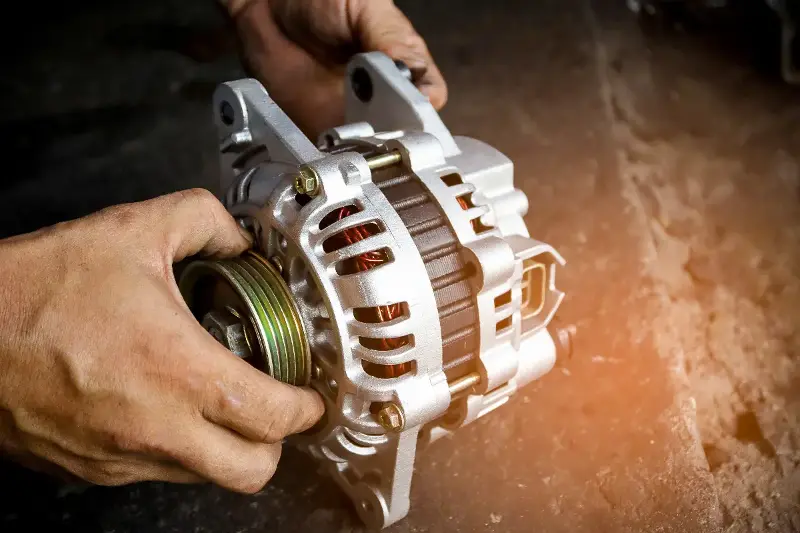
While the battery gets your vehicle started, the alternator takes over the moment the engine begins running. This compact generator transforms mechanical energy from the engine into electrical energy, continuously replenishing the battery and powering all electrical accessories on the go.
The alternator is incredibly efficient, supplying more than enough electricity for your car’s active needs while simultaneously topping off the battery. However, it works exceptionally hard during times of heavy electrical loads, such as when you are simultaneously running:
- Air conditioning or climate control systems
- Heated seats and defrosters
- External electronic gadgets and phone chargers
A weak or failing alternator can lead to flickering interior lights or electrical accessories that behave erratically. To avoid unexpected breakdowns, keep an ear out for squeaking belts under the hood or a battery-shaped dashboard warning light, both of which strongly hint at alternator strain.
THE CIRCUITRY BEHIND THE SCENES
If the battery and alternator are the power plants of your vehicle, the wiring, fuses, and relays make up the automotive electrical grid. Miles of insulated wire snake throughout modern vehicles, delivering power to components as simple as taillights and as high-tech as radar sensors.
The fuse box acts as an indispensable fail-safe, actively protecting those delicate wires from electrical overloads. If you ever lose power to a single accessory—such as a radio turning off or a power window refusing to roll up—while the rest of the car operates perfectly, a blown fuse is almost certainly to blame.
Regular inspection is key. While replacing a fuse is a simple fix, frequently blown fuses indicate deeper wiring issues. Furthermore, if your vehicle is parked outdoors for long periods, keep an eye out for wire damage caused by nesting rodents, which can trigger mysterious electrical shorts.
MODERN AUTOMOTIVE ELECTRONICS
Today’s vehicles have essentially become rolling computers. A typical modern car can contain upwards of 70 separate computers or electronic control modules. These modules communicate continuously over advanced data networks called CAN bus and LIN bus systems. Incredibly, even a basic family sedan now carries more lines of software code than the first space shuttle!
Hybrid and electric vehicles raise the stakes significantly. They operate far beyond the standard 12-volt threshold, utilizing high-voltage battery packs that often reach 400 volts or more. These systems require specialized caution during service but introduce highly efficient electric motors that deliver instantaneous performance. Even your electronic key fob is a part of this network, transmitting an encrypted digital code to let you unlock and drive without a physical key.

ESSENTIAL MAINTENANCE TIPS FOR MAXIMUM PERFORMANCE
As sophisticated as today’s automotive electrical systems are, they still require basic maintenance to prevent costly repairs:
- Clean the Terminals: Inspect battery terminals for corrosion regularly. A white or blue powdery build-up indicates corrosion, which can be gently cleaned away using a mixture of baking soda and water.
- Secure the Mounts: Ensure the battery is firmly secured in its tray; excessive engine vibration dramatically shortens battery lifespan.
- Inspect the Cables: Look out for worn, cracked, or broken battery cables and replace them immediately to prevent electrical arcs.
- Manage Short Trips: If you frequently drive only short distances, your alternator may not have enough time to fully recharge the battery. Consider an occasional longer drive or use a dedicated battery maintainer.
When replacing fuses, always use the exact matching amperage. Swapping in a stronger fuse can overload and permanently damage your vehicle’s sensitive electronics instead of solving the underlying problem. Taking the time to care for this finely tuned network ensures your vehicle's power flows smoothly mile after mile.