


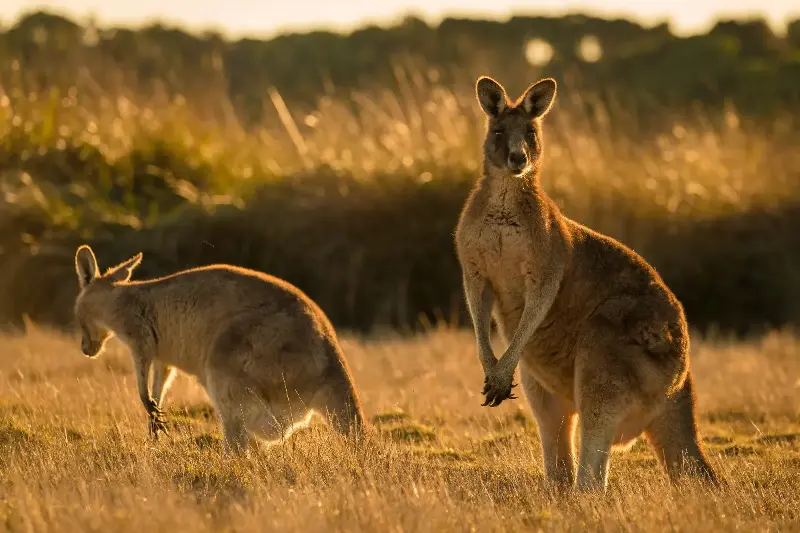
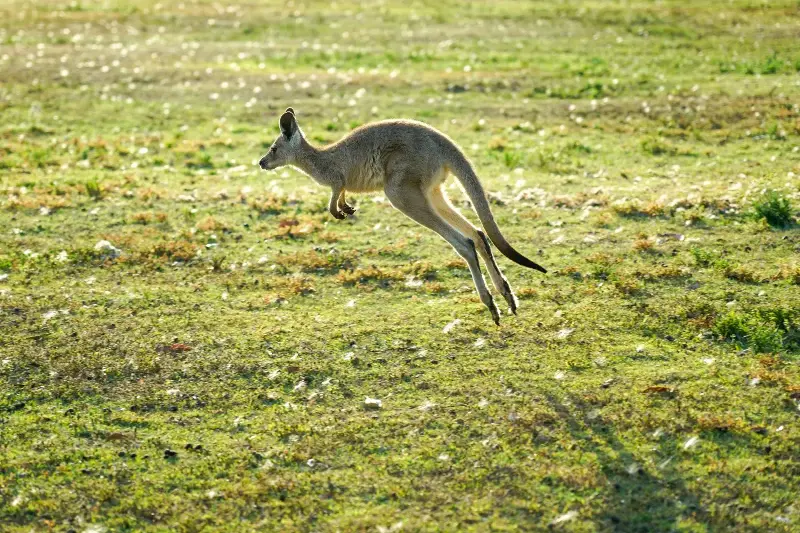
A kangaroo’s hop looks playful and effortless, but it is one of the most efficient forms of land travel in the animal kingdom. Instead of using each stride to push hard against the ground like a running dog, a kangaroo turns its legs and tendons into powerful spring systems. With every landing, elastic tissues store energy; with every takeoff, that energy is released again, allowing the animal to cover long distances while using surprisingly little extra effort.
This ability is especially valuable in Australia’s dry and unpredictable landscapes, where food and water can be scattered across wide areas. Large kangaroos can travel at speeds above 50 kilometers per hour in short bursts, though their preferred traveling speed is far more economical. The faster they hop within a normal range, the less energy they may use per meter traveled.
A Living Spring System
The key to kangaroo hopping lies in the long tendons of the hind legs, particularly the large Achilles tendon. While tendons connect muscles to bones, in kangaroos they act like heavy-duty elastic bands.
- Energy Storage: When a kangaroo lands, its ankle bends and the Achilles tendon stretches, compressing like a mechanical spring.
- Elastic Recoil: As the kangaroo pushes off the ground, the tendon recoils, returning much of that stored energy without requiring extra muscle power.
- Velocity Efficiency: Kangaroos are unusual because their tendons store and release more energy as hopping speed increases, keeping oxygen consumption remarkably steady across varying speeds.
Their long hind feet, strong ankle joints, and large tendons work in total harmony to create a highly effective, continuous bouncing mechanism.

Why Two Legs Are Better Than Four for Hopping
Kangaroos move with both hind legs together, moving in a smooth, rhythmic arc that resembles a pogo stick. While this style might look unusual at low speeds, it becomes remarkably efficient once the animal is traveling quickly.
- Center of Mass: The body drops to store energy in the tendons, then rebounds upward and forward in a fluid motion.
- Counterbalance: The muscular, heavy tail acts as a crucial counterbalance, maintaining air stability and keeping the powerful hindquarters aligned.
- Low-Speed Support: When moving slowly to graze, the kangaroo uses its strong tail almost like a fifth limb, resting it on the ground while swinging the hind legs forward.
Large Bodies, Low Costs
A striking feature of kangaroo locomotion is that larger kangaroos hop even more economically than smaller ones. While larger animals must support greater body mass, their larger, thicker tendons can store and return far greater amounts of elastic energy.
- Massive Stride Length: A large male Red Kangaroo standing over 1.5 meters tall can cover several meters in a single, fluid hop.
- Reduced Muscle Work: Muscles control landings, adjust direction, and provide initial power, but tendons do the bulk of the ongoing work during steady hopping.
- Metabolic Savings: This biological bounce allows large marsupials to traverse vast, open terrain without paying the high metabolic cost of generating fresh force at every step.
Built for Uneven Ground
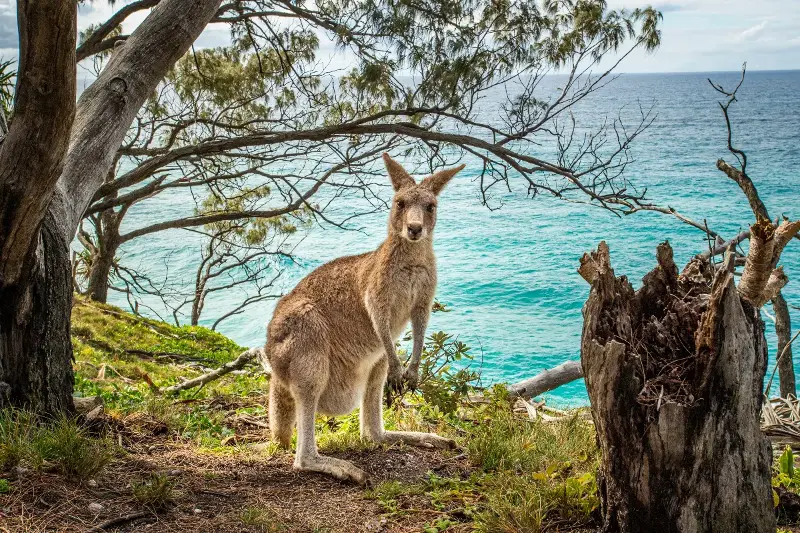
Kangaroos navigate dry grasslands, sandy soils, and rocky terrain effortlessly. Their hopping system is both exceptionally flexible and biologically resilient:
- Joint Adaptations: On firm ground, the leg joints act like stiff springs for fast energy return, while bending deeper on soft ground to absorb impact.
- Maneuverability: By shifting its heavy tail and adjusting foot placement, a kangaroo can make sharp, controlled turns through thick vegetation.
- Developmental Growth: A joey learns this precise, timed bounce gradually after emerging from its mother's pouch, refining the complex coordination as its tendons strengthen.
A Lesson in Efficient Movement
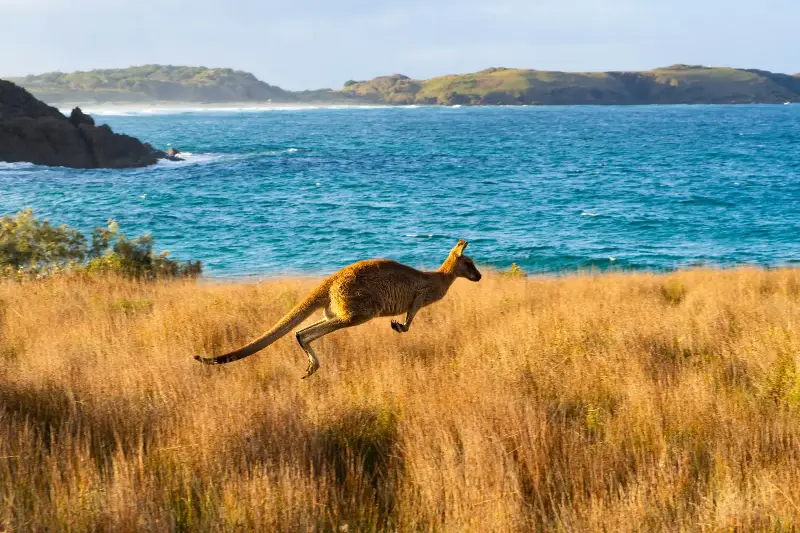
The kangaroo hop has inspired engineers, biomechanists, and robotics researchers worldwide. Many modern legged robots utilize bouncing gaits and flexible energy-return systems modeled directly after marsupial tendons, proving that repeating spring-like motion is far more efficient than rigid mechanical steps.
Efficient movement is not always about producing more force—it is about storing energy wisely and reusing it. Kangaroos have evolved this principle to perfection, turning a simple hop into a masterclass in biological engineering.