


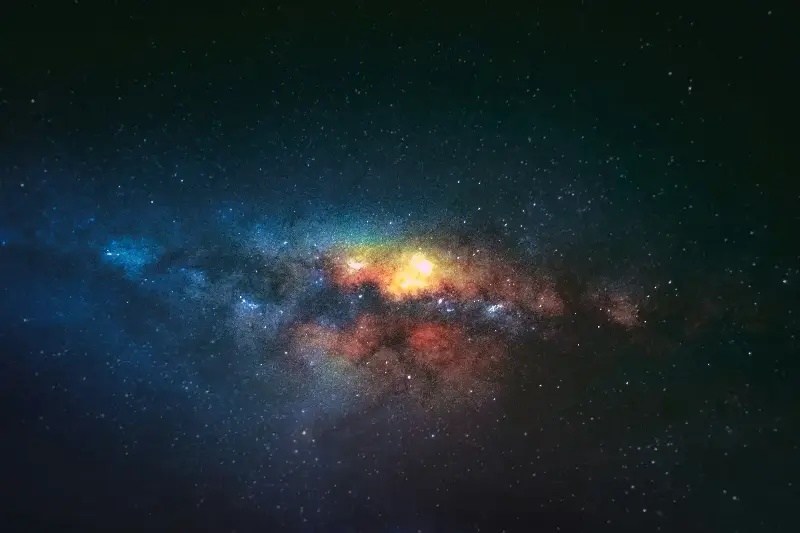
Stars begin as cold, dark patches inside enormous clouds of gas and dust. These stellar nurseries, often called molecular clouds, can stretch for dozens or even hundreds of light-years across space. Although they appear quiet from afar, gravity is constantly at work inside them. A disturbance—such as a collision between clouds or radiation pressure—can trigger part of a cloud to collapse.
As the material falls inward, it becomes significantly denser and hotter. A spinning disk of gas forms around the growing core, creating an early object known as a protostar.
While a protostar is not yet a true star because it has not begun nuclear fusion, its future is actively taking shape through several key developments:
-
Inward gravitational collapse pulls surrounding mass toward the center.
-
Core temperatures rise rapidly as kinetic energy turns into heat.
-
Narrow gas jets occasionally launch outward from the spinning poles.
The Ignition of a New Star
A star is officially born when the core of a protostar becomes hot and dense enough for hydrogen atoms to fuse into helium. This milestone occurs at extreme temperatures of roughly 10 million degrees Celsius. Fusion releases an extraordinary amount of energy, creating an outward pressure that balances the inward pull of gravity.
This equilibrium marks the start of the main sequence, the longest and most stable phase in a star's lifetime. Our sun is currently a main-sequence star, having burned steadily for 4.6 billion years with approximately 5 billion years remaining.
A star's mass dictates almost every aspect of its lifecycle:
-
Massive stars: Burn through their abundant fuel rapidly, lasting only a few million years.
-
Sun-like stars: Maintain a stable main-sequence phase for roughly 10 billion years.
-
Red dwarf stars: Consume fuel so slowly that they can shine for trillions of years.
A Balance of Gravity and Light
During the main sequence, stars maintain a state of hydrostatic equilibrium. Gravity continually attempts to compress the star, while thermal pressure from fusion pushes outward. If gravity gains the upper hand, the core contracts and heats up; if outward pressure dominates, the star expands and cools. This self-regulating cycle keeps stars shining steadily.
Stars are also the primary cosmic factories of the universe. Through ongoing fusion, lighter elements transform into heavier ones:
-
Hydrogen fuses into helium during the primary lifecycle.
-
Helium fuses into carbon and oxygen in later stages.
-
Heavy elements like silicon and iron forge in massive stellar cores.
Much of the material forming planets and living organisms was forged inside ancient stars. As Carl Sagan famously observed, "We are made of star-stuff."
The Aging Process of Sun-Like Stars
Eventually, a star exhausts the hydrogen in its core. Without fusion pressure, the core contracts while the outer atmosphere expands dramatically, turning the star into a red giant. In several billion years, our sun will swell to engulf the inner planets before shedding its outer layers into space.
This expanding shell of illuminated gas forms a planetary nebula. At the center of this nebula, the remaining core cools into a dense white dwarf. A white dwarf packs a mass comparable to the sun into a volume roughly the size of Earth, slowly fading over trillions of years.
The Supernova Endings of Massive Stars
Massive stars experience a far more explosive conclusion. After evolving into red supergiants, they fuse progressively heavier elements in concentric layers around their cores.
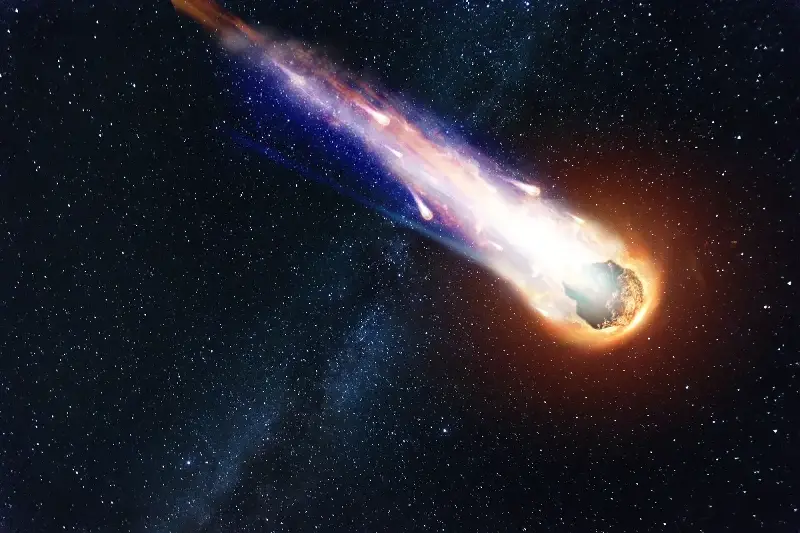
The process halts when iron accumulates in the center. Fusing iron consumes energy rather than releasing it, causing the core to collapse in seconds. The outer layers crash inward and rebound in a cosmic explosion known as a supernova.
Supernovae serve vital roles in galactic evolution:
-
Elemental synthesis: Forging heavy elements like gold, uranium, and iodine.
-
Enriching space: Scattering essential elements across interstellar clouds.
-
Triggering star birth: Compressing nearby gas to initiate new stellar generations.
Extreme Remnants: Neutron Stars and Black Holes
After a supernova, the remaining core collapses into one of the universe's most extreme entities:
-
Neutron stars: Formed if the core remnant is moderate in mass. These objects crush protons and electrons into neutrons, packing immense mass into a sphere just 20 kilometers wide. Fast-spinning variants with magnetic beams are known as pulsars.
-
Black holes: Formed when the remnant core is so massive that gravity overcomes all known forces. The core collapses beyond an event horizon—a boundary from which nothing, not even light, can escape.
From a dark molecular cloud to a white dwarf, neutron star, or black hole, every star follows a remarkable journey shaped by mass, gravity, and time.