



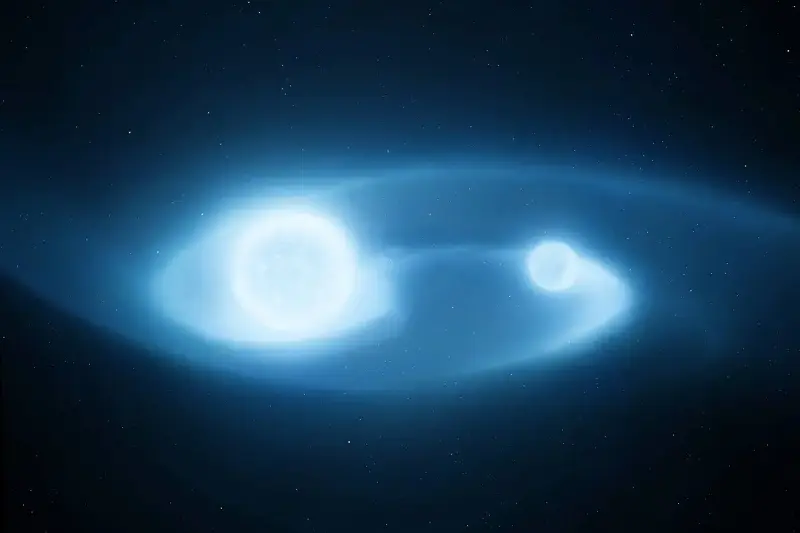
Astronomers have witnessed a star nearly the same size as the Sun get swallowed by a neighbouring supergiant star in a first-of-its-kind merger.
An international team led by Columbia University observed the event, known as AT 2025abao, occurring in the Andromeda galaxy roughly 2.5 million light years from Earth.
The discovery, published in the journal Nature, offers an unprecedented look at a poorly understood stage of binary star systems, in which two stars orbit one another before eventually merging.
Astronomers have long suspected that stars can engulf their neighbours as they expand towards the end of their lives, but they have never before been able to follow the process through to its explosive conclusion.
“Stellar mergers are very, very difficult to observe in real time because they are hard to predict,” said Viraj Karambelkar, a Nasa Hubble Fellow at Columbia University in New York who was the first author of the study detailing the celestial event.
“We noticed something unusual was going on in 2023 and continued to monitor the system to see what it would do. Then, in 2025, it erupted.”
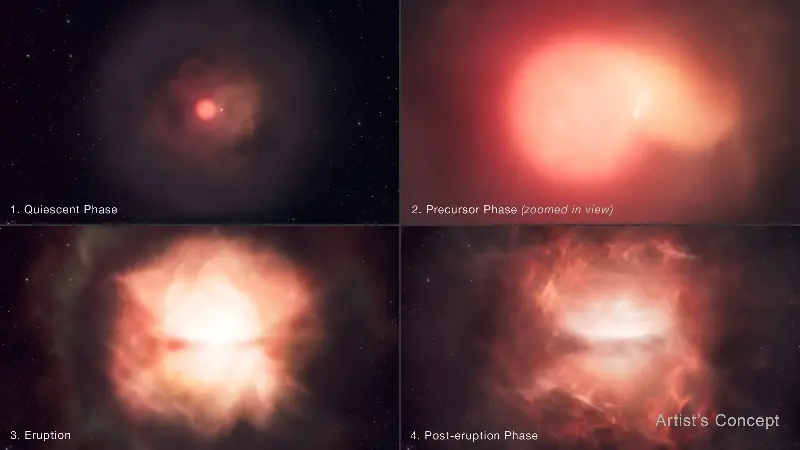
The two stars, dubbed Big Bao and Little Bao, had spent millennia orbiting one another as a binary pair before the eruption.
Big Bao had expanded to approximately 350 times the Sun’s radius and was shining around 18,000 times brighter before the merger.
Once the collision began, it took just seven orbits to unify. Previous mergers have occurred over thousands of orbits.
“We thought an outburst from such an extended star would take years,” said Nadia Blagorodnova, an associate professor at the University of Barcelona in Spain and one of the co-authors of the study.
“One day its brightness started rising and within a week, it peaked.”
The observation offers a new approach to reconstructing astronomical events. Astronomers have previously used such breakthrough findings to reverse-engineer events that happened millions of years ago.
The findings were published on Wednesday in a paper titled ‘An inspiral of a star inside a common envelope with its giant companion’.