



A week after calling Christopher Nolan’s The Odyssey “abysmal”, classicist Emily Wilson has doubled down on her criticism, describing it as “visually stunning” but “emotionally empty”.
Writing in The Atlantic, a week after her blistering review of the film for the London Review of Books, Wilson said Nolan’s adaptation ultimately fails to live up to its own ethical ambitions.
“Nolan’s Odyssey is itself a kind of Trojan horse,” Wilson wrote. “The script grandly insists on the importance of human kindness, while the camera shows us an entirely different set of values.”
“In these times of hatred and misinformation, we need more than the ‘apparent magic’ of deceptive images. We need art that is truthful about the costs and the necessity of compassion,” she wrote.
She added those lessons were present in Homer and Virgil but “elided by Nolan’s visually stunning, emotionally empty film”.
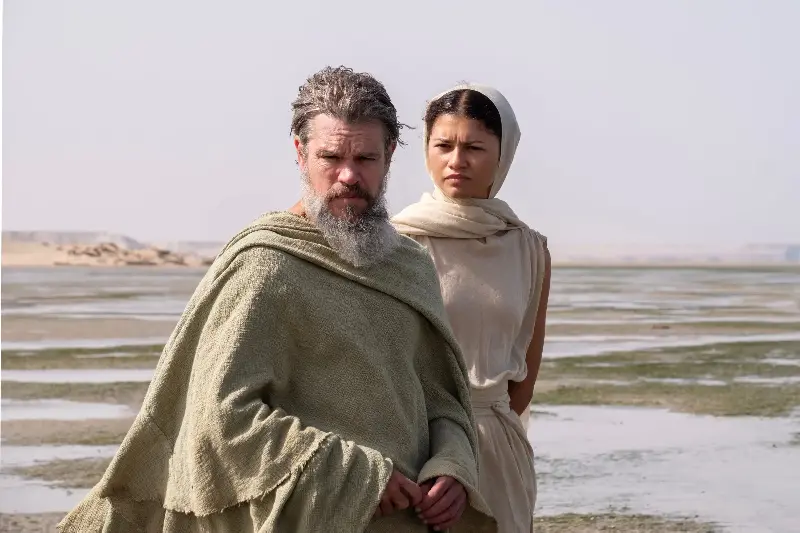
Released last month, The Odyssey is Nolan’s adaptation of Homer’s ancient Greek epic, following Odysseus’ perilous journey home to Ithaca after the Trojan War. Matt Damon stars as the king of Ithaca, with Anne Hathaway as his wife Penelope and Tom Holland as their son Telemachus. The ensemble cast also includes Zendaya as the goddess Athena, Charlize Theron as the nymph Calypso, Robert Pattinson as the suitor Antinous and Himesh Patel as Odysseus’ second-in-command, Eurylochus.
The film has received rave reviews and is expected to be a major Oscar contender, with The Independent’s Clarisse Loughrey calling The Odyssey Nolan’s “best film to date” in her five-star review.
In The Odyssey, the Trojan Horse is presented as the ultimate breach of what characters repeatedly call “Zeus’ law”, a principle of hospitality and kindness towards strangers.
Wilson argued that the idea never fully makes sense because the film “does not explain what ‘hospitality’ has to do with a narrative situation in which the Greeks have been besieging Troy for 10 years already”.
“The Trojans are not their hosts but their enemies in war,” she wrote.
Wilson wrote that the film is more interested in how war is staged than in what it does to people.
She contrasts Nolan’s adaptation with Homer’s Odyssey and Virgil’s Aeneid, arguing that both poems are deeply interested in how people deceive, why others believe them and the human consequences that follow. Nolan’s film, by contrast, is “not interested in the social or psychological questions of how people deceive and are deceived”.
Instead, she wrote that the film dwells on “the logistics” of hauling the horse ashore, moving weapons and breaching city gates. “The script tells us loudly that people matter,” she wrote, “but the camera shows us that what matters is the mechanical challenge of moving objects through space.”
Wilson also revisited one of the strongest criticisms from her original review, questioning Nolan’s decision to film scenes in Dakhla, in the Moroccan-occupied territory of Western Sahara, without the consent of the Indigenous Sahrawi people. The production drew criticism last year from Sahrawi activists and the Western Sahara International Film Festival (FiSahara), who argued that filming in the disputed territory risked legitimising Morocco’s decades-long occupation.
She argued that the choice sits uneasily with a film concerned with the ethics of invading other people’s homes, calling it “the lack of seriousness in Nolan’s thinking about his themes”.
In her previous review, Wilson had written that Nolan’s film strips away much of what has made Homer’s epic endure for nearly 3,000 years, and “lacks psychological, emotional, political and ethical depth”.
Wilson, who became the first woman to publish a complete English translation of The Odyssey in 2017, had previously been named by Nolan as an influence on the film. In an interview with Empire magazine in November 2025, the director said it was the opening line of Wilson's translation – “Tell me about a complicated man” – that unlocked his approach to Odysseus.
Her review even led to novelist Joyce Carol Oates coming to Nolan’s defence, who criticised Wilson’s “tone of dismissal & haughty superiority” and accused her of speaking in “the crude language of MAGA folks” instead of engaging with his interpretation of Homer “in a collegial manner”.
The Odyssey is screening in theatres now.