



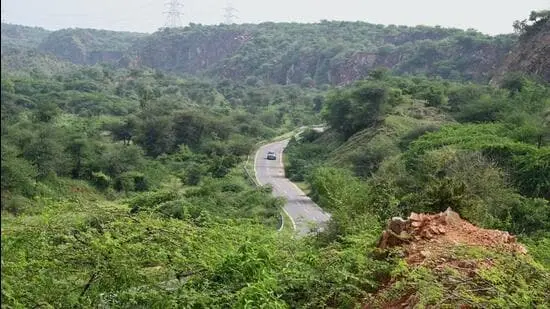
The Centre has backed the Central Empowered Committee’s (CEC’s) proposed 10-member high-powered expert committee to come up with a uniform definition for the Aravalli mountain range.
In an affidavit filed with the Supreme Court earlier this week, the ministry of environment, forests and climate change (MoEFCC) fully endorsed the names suggested for the high-powered expert committee (HPEC). Kanchan Devi, the current director general of the Indian Council of Forestry Research & Education (ICFRE) is proposed to chair the committee.
The CEC recommended nine members, comprising in-service and retired bureaucrats associated with the Forest Survey of India (FSI), Geological Survey of India (GSI) and Survey of India, along with academicians. The joint secretary of MoEFCC was proposed as the convenor of the panel.
The affidavit filed on March 10 said, “The MoEFCC respectfully submits that it has no objection if this court considers the aforesaid suggested names for the constitution of the proposed High Powered Committee. It is further submitted that the Ministry does not have any additional names to propose at this stage for inclusion in the said committee.”
The affidavit was filed in response to an order passed by the top court on February 26, requiring suggestions for the panel from the MoEFCC and other stakeholders. The CEC had submitted its proposal of names to the court on February 9, which MoEFCC studied before reaching this conclusion.
The Centre said, “The aforesaid aspects relating to the Aravalli Hills and Ranges require a comprehensive and analytical examination, including stakeholder consultation, by a group of domain experts in the relevant fields.”
It said that the proposed HPEC can address these aspects by incorporating them into its “Terms of Reference”.
In its report to the court, the CEC stated that Kanchan Devi— the proposed HPEC chairperson—is a 1991 Indian Forest Service officer from the Madhya Pradesh cadre, who is the first woman to head the ICFRE. She assumed charge in December 2023 and has over three decades of experience in forestry education and research, wildlife and forest policy, and institutional leadership.
As panel members, the CEC recommended Subhash Ashutosh, a former director general of FSI, who is a nationally recognised expert in forest resource assessment and geospatial applications, along with former GSI director Rajendra Kumar Sharma, who played a key role in exploration of the Aravalli-Delhi fold belt in Rajasthan, specialising in proterozoic rock systems and gold and base-metal mineralisation.
The other experts proposed include climate and energy policy expert Tejal Kanitkar, senior academician and life sciences researcher Jaya Parkash Yadav, senior geographer and scholar Tejbir Singh Rana, former additional surveyor general of India SV Singh, former Gujarat principal chief conservator of forests (PCCF) CN Pandey, and former Nagaland PCCF Dharmendra Prakash.
In addition to the proposed composition of the 10-member panel, the CEC recommended two other names—RN Mishra, a noted author of regional geography who wrote the book “Trees of Rajasthan”, and Vijay Dhasmana, an ecological restoration practitioner and conservationist.
The court had invited suggestions for the panel from all stakeholders, and the names proposed jointly by CEC and MoEFCC will be crucial in this regard. The court is yet to finalise the panel, which is expected to be done on March 20, when the matter is next listed.
On November 20, 2025, the top court had laid down a common definition for Aravalli hills and range as proposed by an eight-member committee headed by MoEFCC secretaries. This committee had said that any landform located in the Aravalli districts with an elevation of 100 metres or more from the local relief shall be termed the Aravalli hills. Similarly, it stated that two or more Aravalli hills located within 500 metres of each other shall form an Aravalli range.
Following widespread criticism and concern that such a definition would encourage illegal mining and harm the ecological integrity of the Aravalli ecosphere spanning across Gujarat, Rajasthan, Haryana and Delhi, the top court took suo motu cognisance of the matter on December 29, 2025, and placed its earlier order of November 20 on hold.
By the same order, the court held that no permission shall be granted for mining, whether new mining leases or renewal of old mining leases. It also laid down a fresh assessment of the Aravalli definition to be undertaken by HPEC that includes a detailed identification of the territories to be excluded from protection under the uniform Aravalli definition and scope for ‘sustainable” or “regulated” mining in the newly demarcated Aravalli areas.