



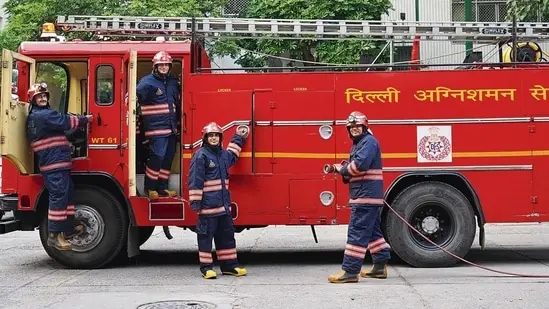
The Delhi Fire Services (DFS) is preparing a proposal to make it mandatory for all buildings in the national capital to obtain fire safety clearances or “no objection certificates (NOCs)”, amid growing concerns over public safety following the recent blaze in east Delhi’s Vivek Vihar that killed nine people.
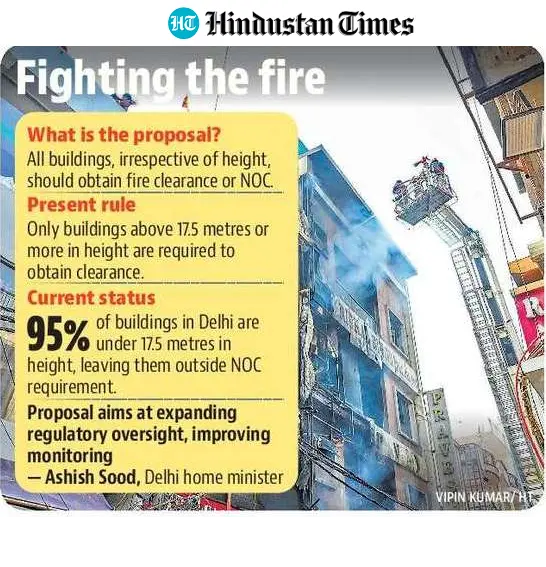
Currently, fire NOCs are required under the National Building Code (NBC) for buildings with a height of 17.5 metres or more, a threshold that is proposed to be lowered. The proposal will soon be submitted to the government for approval.
According to officials, nearly 95% of buildings in Delhi are under 17.5 metres in height, leaving them outside the mandatory fire clearance framework. Delhi home minister Ashish Sood said the proposal is aimed at expanding regulatory oversight and improving monitoring of unsafe structures.
“We are working on a report wherein we will propose that all buildings and structures in Delhi mandatorily obtain a fire NOC without any height restriction. Presently, over 95% of structures in Delhi don’t need to get a fire NOC. This will help us regulate construction activities that are unsafe. We are looking at how all new as well as older buildings can be brought under the ambit of fire certification,” Sood said.
A DFS official aware of the developments said authorities have also proposed mandating fire sensors and water sprinkler systems in all houses and commercial units.
“The time for a fire to escalate into its fatal nature has reduced as compared to previous years because of the lack of ventilation in houses. Therefore, it should become mandatory for residents to have sensors and sprinklers,” the official said.
The move comes around 10 days after a major fire broke out in a residential building in Vivek Vihar, triggering renewed scrutiny of compliance with building safety norms, evacuation systems and electrical infrastructure.
Officials familiar with the preliminary findings said the fire spread rapidly due to the “stack effect”, a phenomenon in which heat and smoke rise quickly through vertical shafts inside buildings.
A DFS official said staircases, lift shafts and service ducts can act as channels during a fire, creating strong upward air movement that intensifies flames and pushes smoke to upper floors. “This creates a strong upward movement that pulls in fresh air from lower levels, intensifying the flames and allowing smoke to travel quickly to upper floors, significantly hampering evacuation efforts,” the official said.
Officials said the building involved in the incident was taller than 15 metres but below the current 17.5-metre threshold and therefore did not require a fire NOC.
The incident has prompted wider discussions within the government on fire prevention and electrical safety measures, particularly during the summer months when power demand rises sharply across the Capital.
“That is why the city also needs a comprehensive power audit, as well, along with fire safety audits. We are proposing that as well,” said Sood.
A paper prepared on “Fire Prevention & Electrical Safety in Delhi” has called for inter-departmental consultations involving the Delhi Fire Service, Delhi Disaster Management Authority, discoms and municipal agencies.
The document flagged recent fire incidents in slums, middle-class colonies, hospitals and high-end residential areas, including Vivek Vihar, and stressed the need to focus on prevention rather than only emergency response.
The report identified faulty electrical systems, illegal wiring, overloaded connections and defective air-conditioners among the major causes of recent fires in the city. It proposed pre-summer electrical load audits, replacement of ageing cables and transformers, and deployment of smart metering and overload detection systems in high-risk areas. The report also recommended mock drills in schools and hospitals.
“Among the short-term measures proposed are special fire safety drives in vulnerable colonies, action against illegal wiring and unsafe electrical connections and public advisories on air-conditioner usage and load management during peak summer,” Sood said.