



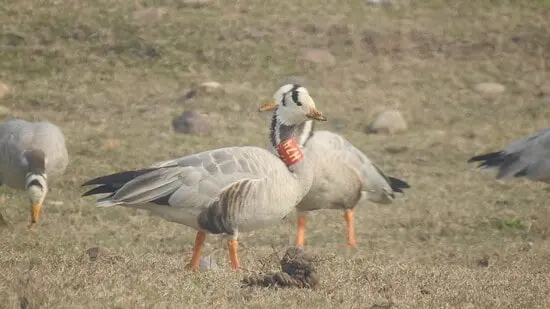
After being sighted in 2022 and 2023, a migratory bird, tagged in 2011, has once more been sighted at the Pong Dam wetland, marking another chapter in the journey of more than a decade.
The migratory bird, ringed in March 2011, was sighted again recently in the same wetland with an identification tag around its neck, officials have confirmed.
Experts term it a historic milestone in biodiversity conservation and scientific monitoring. The Pong Dam wetland, nestled in the picturesque Kangra valley of Himachal, recorded over 1.24 lakh waterfowl flocking the wetland, including 62,293 Bar-headed Geese this year. The elegant-shaped bird descends at the Pong wetland in large numbers starting from October and stays here till March.
Deputy conservator of forests (wildlife) Reginald Royston said that according to information shared by scientists of the Wetlands Programme of the prestigious Bombay Natural History Society (BNHS), the concerned migratory bird, which is a Bar-Headed Geese, has returned to the same wintering site, Pong Dam Lake, even after such a long interval. “The bird has been recorded with photographic evidence. Earlier the bird was sighted in 2022 and 2023. From an ornithological perspective, this is considered extremely significant,” he said.
Experts explain that the tendency of migratory birds to repeatedly return to a specific site is known as site fidelity. The return of the same bird after 15 years indicates that the ecological conditions of Pong Dam Lake, such as food availability, water levels, and security, remain favourable. This stands as a living testament to the success of long-term conservation efforts.
“The process of ringing or tagging provides scientists with invaluable information about birds’ age, migration routes, behaviour, health, and lifespan. Data obtained from Pong Dam Lake will help guide bird conservation policies at both national and international levels in the future,” said Royston.
“The consistent conservation efforts undertaken by the forest department, environmental organisations, and scientific institutions are now showing concrete results. Measures such as controlling illegal hunting, maintaining water quality, conducting migratory bird censuses, awareness programs, and research activities are being implemented through various institutions and their impact is clearly visible. The safe return of a bird tagged 15 years ago proves that Pong Dam Lake continues to be a secure and dependable refuge for migratory birds,” officials said.
Reginald Royston further stated that every winter Pong Dam Lake serves as a major refuge for migratory birds arriving from various parts of Asia and Europe. According to different studies, more than 220 bird species are found in the lake, including 100–120 species of migratory birds and over 90 resident species. In good years, the winter migratory bird population ranges between 120,000 and 150,000.