



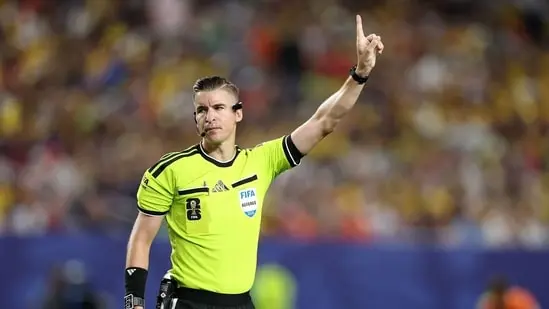
Francois Letexier arrived at Argentina vs Egypt with one of the strongest refereeing profiles in world football, but left the Round of 16 carrying one of the tournament’s biggest officiating controversies.
The 37-year-old French referee, born in Bédée, Brittany, is among UEFA’s highest-rated officials. A legal professional away from football, Letexier became the youngest referee to officiate in Ligue 1 in 2016 and has been on FIFA’s international list since 2017. His rise has been rapid and prestigious. He refereed the 2023 UEFA Super Cup between Manchester City and Sevilla, was fourth official for the 2024 Champions League final, and then took charge of the UEFA Euro 2024 final between Spain and England.
Letexier was also named the world’s best male referee for 2024 by the IFFHS, underlining his standing as one of Europe’s most trusted officials. That reputation, however, came under intense scrutiny after Argentina’s 3-2 win over Egypt, where several major calls left the African side furious.
The Decisions That Put Letexier Under Fire
The first big call came in the 19th minute, when Haissem Hassan brought down Nicolas Tagliafico inside the penalty area. Letexier immediately pointed to the spot. Lionel Messi stepped up, but Egypt goalkeeper Mostafa Shobeir saved the penalty. On its own, the decision was not the night’s biggest flashpoint, but it set the tone for the referee’s threshold on contact inside the box.
Earlier, Egypt felt they should have had a dangerous free-kick when Mohamed Salah was clipped by Leandro Paredes near the edge of Argentina’s area. Letexier waved play on, a decision that later became part of Egypt’s broader complaint: similar physical contact, they felt, was not being judged consistently at both ends.
The major controversy arrived in the 58th minute. Egypt thought they had gone 2-0 ahead when Mostafa Ziko finished a counter-attack involving Haissem Hassan and Salah. But VAR intervened and asked Letexier to review an earlier incident in the move. Marwan Attia was judged to have pulled Lisandro Martinez’s shirt and stepped on his foot in the build-up. After checking the monitor, Letexier disallowed the goal.
Technically, VAR can review an attacking-team offence in the attacking phase of play before a goal. But the problem for Egypt was the depth of the review. The foul had occurred much earlier in the move, reportedly more than 30 seconds before the ball went in. That created the feeling that VAR had searched deeply to find a reason to cancel Egypt’s goal.
The inconsistency argument became stronger late in the match. Egypt appealed for a penalty when Alexis Mac Allister appeared to tug Hamdy Fathy inside the box. No penalty was given. Moments later, Argentina broke forward, and Enzo Fernandez scored the stoppage-time winner.
That sequence became the heart of Egypt’s anger. VAR had gone back a long way to punish Egypt before Ziko’s disallowed goal, but did not intervene with the same intensity when Egypt claimed a penalty immediately before Argentina’s winner.
Also Read: Lionel Messi shrugs off penalty miss, inspires dramatic Argentina comeback to knock Egypt out in VAR-marred game
Egypt were also furious about what they believed was a foul in the build-up to Fernandez’s decisive goal. Their frustration then spilled over, with Letexier showing yellow cards to Shobeir, Fathy, Attia and coach Hossam Hassan.
The controversy, therefore, was not simply about one call. It was about perceived inconsistency. Letexier entered the match as one of the game’s elite referees. He left it at the centre of a debate over whether VAR was applied to both teams to the same standard.