



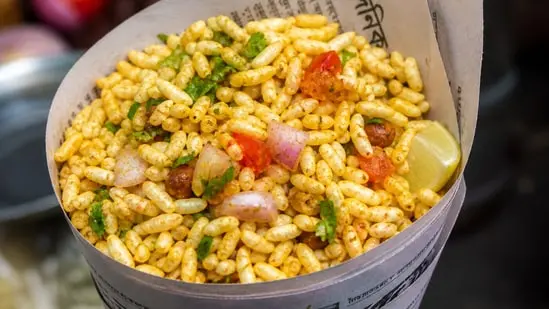
Never in the many decades since it was invented has jhal moori been as famous as it is today. Those of us who know Kolkata well (essentially people who have lived or worked there) have long been familiar with the dish. But the rest of India only began to wonder what it was after the recently concluded election campaign for the Bengal assembly.
It was during the campaign that Prime Minister Narendra Modi made what was described as an unscheduled stop to buy a packet of jhal moori. The symbolism was clear. The BJP was not the party of outsiders. Its leader loved such typically Bengali snacks as jhal moori.
Jhal moori goes national
Judging by the election results, the symbolism worked. The BJP swept the polls and is now preparing to take power. And all of India now thinks of Bengal in terms of jhal moori and not just of fish.
The Prime Minister is a vegetarian, so I guess fish was never an option for him. Jhal moori on the other hand is entirely vegetarian and most of us Gujaratis already love its primary component: moori which we call mumra and which features prominently in our food either fried, mixed with sev and peanuts or, in its greatest avatar, as the core of bhelpuri.
Also read: The Taste by Vir Sanghvi: Is an airport concierge worth the money? It depends on your age and your destination
The Gujarati snacks are well known outside of Gujarat. But jhal moori has not travelled as much or as well. Which made it the perfect example of a particularly Bengali street food and the Prime Minister’s mention not only thrilled Bengal’s voters (well, they voted for the BJP, didn’t they?) but also made the dish nationally famous.
And the symbolism may have been more appropriate than the Prime Minister realised given that the BJP was trying to make a mark in Bengal. Like the BJP itself, jhal moori was created by North Indians but became so popular in Bengal that Bengalis regard it as their own.
The migrant roots of a ‘Bengali’ classic
One of the ironies of Kolkata’s most famous dishes is that while Bengal boasts of a great cuisine, the dishes we most associate with the city have very little to do with Bengali cuisine. The puchka was originally brought to Kolkata by chaatwallas from UP (one theory is they came from Benares). The kathi kabab roll (the Nizam’s roll) was also invented by people from the Hindi belt. The famous Kolkata biryani traces its origins to the Nawab of Awadh’s court in exile in Metiabruz.
Until the Prime Minister’s stop focused attention on jhal moori I had always regarded it as entirely Bengali. After all, Kolkata was the first place I ever tried it. At the old Sunday magazine offices we survived on jhal moori when we worked late into the night trying to close the magazine in time for the printers’ deadline.
I was not an instant convert to the dish because, as you might expect of a Gujarati from Mumbai, I treated it as bhelpuri made by some unfortunate person who had no access to the chutneys that elevate bhelpuri to ethereal status. It took me time to appreciate the dry texture, the tang of the lemon and most of all, the mustard oil that gave jhal moori its distinctive taste.
So how long has it been an integral part of Kolkata’s food culture? I called Pritha Sen a former colleague from my jhal moori eating Sunday magazine days who has gone on to become the greatest historian of Bengal’s food culture.
Also read: The Taste by Vir Sanghvi: Anantara's ambitious expansion aims to bring Asian hospitality to India with 50 new hotels
Pritha gave me some perspective on Bengal’s street food culture. She said that it only developed after the British established Kolkata as a great city. The first foods served in street stalls and little restaurants were, she said, more Islamic in origin: kababs and parathas. As has often been noted, Hindus were less keen - all over India - to eat food made outside their homes.
This changed when people had no alternative but to eat nearer their places of work and especially as migrants from all over India streamed into the booming city.
Kolkata was introduced to kachori stalls, for instance, after Marwaris set up shop in Burra Bazaar.
Many, if not most, of the innovations in street food came from migrants from UP and Bihar. In some cases, they just served dishes from their own regions but often they adapted their dishes to suit local ingredients and palates.
Moori has always been around in Bengal. It appeals to a land of rice eaters, and it has a particular appeal to those looking to fill themselves up cheaply and quickly. It’s not expensive and most people find it more filling than rice.
Pritha reckons that Kolkata’s street food scene only picked up in the 20th century between the two World Wars. Jhal moori made an impact in the 1940s when everyone in Kolkata began to appreciate the tangy dishes that migrants from the Hindi belt were making, sometimes with ingredients that Bengalis were already familiar with.
This is not unprecedented. Bhelpuri seems to have become popular in the same time frame when Mumbai’s Gujaratis adapted the style of UP chaatwallas (who had migrated to the city) to create another great moori dish. The difference is that in the case of bhelpuri we know of specific restaurants (such as Gokul) that are supposed to have created it, which is not true of jhal moori. And while there are famous Gujarati restaurants in Mumbai that serve bhelpuri ( Swati , Soam, etc) jhal moori never really became a restaurant dish but remained a street snack.
Will jhal moori catch on all over the country now that the Prime Minister has made it famous? It could. But frankly I am a little sceptical. The South is not so keen on chaat and in the north they don’t seem to love moori as much as Gujaratis and Bengalis do. Even bhelpuri is not a great favourite in Delhi, for example.
But no matter. The BJP has got what it wanted. And when we look back at this era, we will remember that for one brief shining moment, jhal moori got all of India talking.