



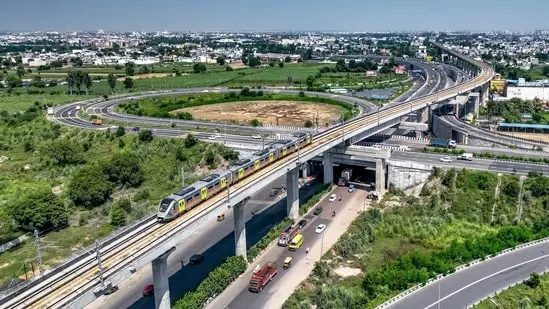
Prime Minister Modi on Sunday inaugurated the remaining sections of the Namo Bharat rapid rail transit system (RRTS) Delhi-Ghaziabad-Meerut network—a 5km section between Sarai Kale Khan and New Ashok Nagar in Delhi and a 21km section between Meerut and Modipuram in Uttar Pradesh—marking the complete operationalisation of the RRTS project. This also positions the Sarai Kale Khan station as one of the biggest multimodal transportation hubs in Delhi, integrating RRTS with the Delhi Metro, railway network, interstate bus terminal and the Ring Road.
Union minister Manohar Lal Khattar and Delhi LG VK Saxena flagged off the RRTS at the Sarai Kale Khan station on Sunday.
Khattar said that the Metro network in Delhi—combining the Delhi Metro and the Delhi section of the RRTS—has surpassed its counterpart in the American city of New York. “This route will greatly benefit the people of Delhi, Meerut, and everyone living in between. Where once it took three hours by road, it now takes just 55 minutes....Delhi had a Metro network of around 393km and with the addition of the RRTS (Delhi section), the Metro rail network in Delhi has reached around 420km. New York’s Metro route is around 399km and Delhi Metro network has surpassed it today,” Khattar said.
ALSO READ | PM Modi flags off Namo Bharat RRTS, Meerut Metro | Video
The minister said that RRTS is another form of fast moving metro rail.
The Union minister said in the coming years, Sarai Kale Khan is set to emerge as an even bigger multi-modal transport hub. “After receiving approval from the cabinet, work on the rapid rail to Karnal, Bawal, and Neemrana connecting Haryana and Rajasthan will commence from Sarai Kale Khan.
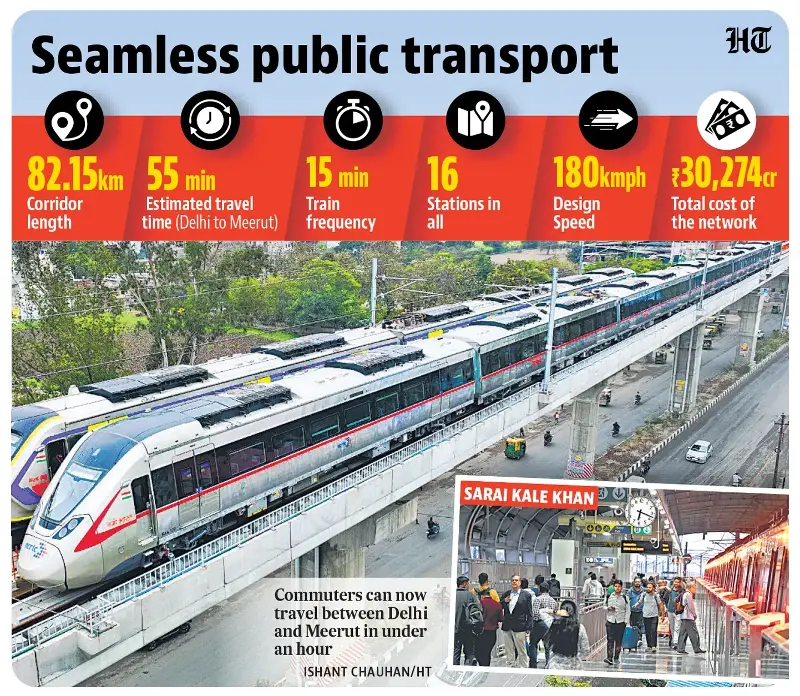
In a statement, chief minister Rekha Gupta also hailed the project for ensuring ease of living. “The corridor will substantially reduce travel time and make daily commuting far more convenient than before. In view of Delhi’s growing population pressure and commuting challenges, the project will make a significant contribution to the city’s overall development. It will stimulate economic activity in Delhi-NCR, strengthen employment opportunities and accelerate balanced regional development,” she said.
Integrating transport modes
Officials with the National Capital Region Transport Corporation (NCRTC) said it is constructing a 280-metre-long foot overbridge (FOB), equipped with six automatic travelators, to connect the RRTS station with the Hazrat Nizamuddin Railway Station.
ALSO READ | Delhi–Meerut RRTS now fully operational: Will improved connectivity drive real estate demand along the corridor?
“This will ensure safe, seamless, and fast connectivity between the two transportation hubs. Civil construction of the FOB is nearly complete, and all six travelators have been installed. At present, finishing work is going on. It is expected to be open to the public by March,” an official, requesting anonymity, said.
This station is going to be one of the biggest transportation hubs, connecting Hazrat Nizamuddin Railway Station, Delhi Metro’s Pink Line, Veer Haqiqat Rai ISBT, and the Ring Road. “This will significantly improve connectivity and reduce reliance on private vehicles, helping curb congestion and pollution. It will also ensure smooth, efficient, and convenient travel for lakhs of daily commuters,” the official said.
Spread across a layout that spans 215 metres in length, 50 metres in width, and 15 metres in height, the Sarai Kale Khan RRTS station is designed to handle high passenger volumes efficiently. “To handle large volumes, five entry-exit gates of this station, 14 lifts, and 18 escalators have been set up to ensure easy accessibility and smooth commuter flow across different levels,” the official said.
ALSO READ | India's fastest metro and Namo Bharat RRTS: Meerut's twin projects now running
NCRTC said that multimodal integration has been the tenet of the Namo Bharat project. “It aims to make travel seamless and convenient for the passengers, encouraging modal shift in favour of public transport. For smooth and orderly vehicular movement in and around the station and enhance accessibility, NCRTC has developed a dedicated vehicle drop-off zone under the elevated Sarai Kale Khan station,” NCRTC said in a statement.
A city bus interchange with space for over 15 buses has also been developed beneath the station and parking space at this station can accommodate around 275 cars and 900 two-wheelers. With the RRTS planning to set up two more corridors—Delhi-Gurugram-SNB-Alwar corridor, and Delhi-Panipat-Karnal corridor—the Sarai Kale Khan station is set to take centre stage.
“All three corridors will converge at the Sarai Kale Khan station in Delhi, enabling interoperability and seamless travel across the region,” the official cited above said.
Officials said that the station has been designed to facilitate interoperability, as the converging point among three priority corridors. “Interoperability will facilitate commuters to travel from one corridor to another without hassle or needing to change trains. To facilitate the same, six platforms with four tracks have been built at Sarai Kale Khan,” the official said.