



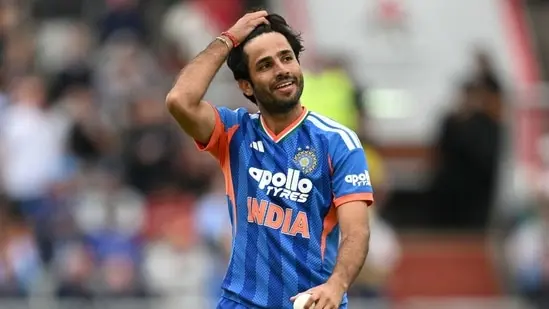
Ravi Bishnoi’s horror night in Manchester should not be treated as just another bad spell from a bowler who will bounce back next game. That would be too simple, too kind and too convenient. India did not lose the second T20I against England only because Bishnoi went for 60 runs, but his spell exposed a selection problem that has been building quietly for some time.
The uncomfortable question is no longer whether Bishnoi can have bad days. Every bowler can. The question is why India keep pushing him as a front-line T20I spin option when his own role has become increasingly difficult to define. If a spinner does not offer control, does not give batting depth, does not regularly produce big turn, and is not even a guaranteed first-choice player in the IPL, what exactly is India promoting?
The Bishnoi problem is bigger than one bad over
The numbers from Old Trafford were brutal. Bishnoi finished with 0 for 60 in four overs. The 17th over became the turning point of the chase, with Jacob Bethell cashing in on free hits after Bishnoi overstepped. For a fast bowler, the occasional no-ball is still damaging. For a spinner, three no-balls in a T20I are almost impossible to defend.
A spinner is picked to bring control into chaos. Bishnoi brought more chaos. India had done the hard part early, with Arshdeep Singh removing both England openers in the first over. England were 1 for 2. India had 190 on the board. The match did not require Bishnoi to produce genius. It required basic discipline, smart lengths and a refusal to gift England release balls.
Instead, the spell did the opposite. It turned pressure into permission. It allowed Bethell to move from controlled aggression to complete domination. Once a spinner starts bowling no-balls and then serves up free hits, the tactical plan disappears. At that point, it is no longer about match-ups. It is about survival.
That is where India’s selection logic deserves scrutiny. Bishnoi is often spoken of as a wrist-spinner, but his actual bowling is not that of a classical leg-spinner. He is far more of a googly-first bowler. The stock leg-break is not his defining weapon. He rarely looks like a spinner trying to beat batters with big drift, dip and sharp turn. His ball does not consistently rip off the surface. His method is built more on pace through the air, flatter trajectory, awkward angles and the wrong’un.
There is nothing wrong with that style if it works. Modern T20 cricket has room for non-traditional spinners. But the problem begins when the disguise fades, and the control goes missing. A traditional wrist-spinner can still be backed because he threatens both edges. A mystery spinner can still be backed because batters are unsure what is coming. A defensive spinner can still be backed because he gives you four tight overs. Bishnoi, on his worst days, risks falling between all three categories.
If the googly is being picked, if the ball is not turning enough to create doubt, and if his lengths are not tight enough to protect him, then India are not getting a complete spin option. They are getting a bowler dependent on angle and speed. That can be useful in certain conditions, but it is not enough to justify automatic faith at international level.
The IPL context makes this even harder to ignore. Bishnoi moved to Rajasthan Royals after being released by Lucknow Super Giants. That should have been a reset. But the larger question is why a player whose franchise role has not always looked secure is walking straight back into India’s XI. Franchise cricket is not everything, but it is not nothing either. IPL teams watch these players closely in nets, in match-ups, in pressure overs and across long tournaments. If an IPL side itself is not always convinced, India need a very strong reason to be.
Also Read: ‘We all know where we went wrong’: Shreyas Iyer minces no words after India lose third game under his captaincy
This is also where the spin-bowling coach question becomes fair. India now have a specialist spin bowling coach in Sairaj Bahutule. Nobody can fix a bowler overnight, and Bishnoi’s flaws did not appear in Manchester alone. But if India are investing in him, then what exactly is the technical plan? Is he being pushed to develop a stronger leg-break? Is the wrong’un being protected as a surprise weapon rather than used as a default ball? Is there a plan to make him more side-on, more deceptive, more controlled at the crease? Or is India simply continuing with the old label of “wrist-spinner” because it sounds attacking?
That label is dangerous. T20 cricket has moved beyond romantic categories. A wrist-spinner is not valuable because he is called a wrist-spinner. He is valuable if he takes wickets, creates doubt, controls match-ups or changes the tempo of an innings. Bishnoi has had phases where he has done that. But the current version raises too many questions.
Manchester should not end Bishnoi’s India career. That would be reactionary. He is still young enough to improve and skilled enough to rebuild. But it should end the lazy assumption that his selection explains itself. India need clarity, not reputation. They need role definition, not blind backing.
Because right now, the question is painfully simple: if Bishnoi is not spinning the ball big, not controlling the game, not adding batting value, and not coming through a clearly dominant IPL role, why is he being fast-tracked back into India’s T20I XI?