



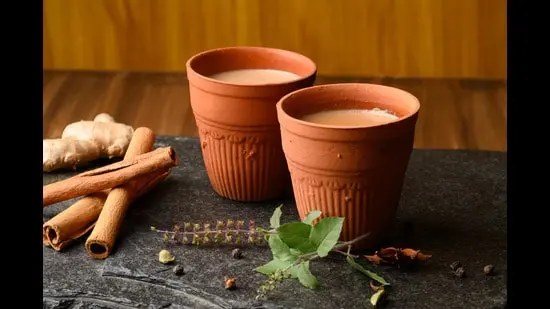
I had lassi in a kulhad this morning, and for a fleeting moment, summer tasted the way it used to. The kulhad rested cool against my palms, its porous clay carrying the faint fragrance of damp earth. Before the lassi even touched my lips, memory arrived quietly, the kind that slips soundlessly into the soul. One sip, and I was back in the sun-soaked courtyard of our home, where afternoons drifted lazily beneath slow ceiling fans, where earthen pots lined shaded ledges, and where kulhads were not curated novelties but companions of everyday living. Even now, that scent rose softly from the rim—mitti after rain, raw and reassuring—as though the earth itself had remembered me.
At home, kulhads were woven into the rhythm of our days. Our milkman brought them from a nearby village along with fresh milk that still carried the memory of grazing fields and dew-drenched dawns. With him arrived a quiet procession of earthen companions—a wide-bellied matka where water rested cool and composed, a patient clay pot where milk transformed overnight into thick, tender curd, and rows of kulhads stacked one upon another like silent participants in family rituals.
We did not treat them as disposable objects. They were rinsed carefully under cool water, the clay darkening momentarily as though reliving its first monsoon. Afterwards, they were left in the courtyard where sunlight slowly sipped away their dampness. By late afternoon, they dried into a muted, mellow brown, carrying the lingering scent of soil and sun. Some developed fine cracks over time—delicate as laugh lines—each one bearing witness to repeated touch, repeated use, and repeated belonging.
There was an unspoken ceremony in the way my mother poured frothy lassi into a kulhad, the creamy foam rising softly to the brim. Chhaaj tasted gentler in clay—less sharp, more rounded—as though the vessel itself softened every edge. In winter, she would pour slow-boiled kesar milk into those same kulhads, fragrant with cream and comfort. Somehow the clay lent everything greater depth, as though earth enriched whatever it embraced.
There was music hidden in those moments—the hollow clink of a kulhad meeting the stone ledge, the soft sigh when steaming chai touched its porous body on fog-laden mornings, and pale ribbons of steam curling upward into cold air while conversations wandered lazily from one story to another. Even silence felt fuller then.
Kulhads have long belonged to the Indian landscape, shaped on spinning wheels by hands that understood both patience and impermanence. At railway stations, roadside stalls, village fairs, and bustling bazaars, they once carried countless fleeting conversations and tired travellers’ comforts. Used, yes, but never truly wasted, because they returned quietly to the soil from which they came. They belonged to a cycle, not a culture of convenience.
And yet, somewhere along the way, our relationship with them changed. The kulhad, once washed and reused with care, became a fashionable novelty—offered with artisanal chai at select cafés only to be discarded moments later. What was once intimate became incidental. We still hold the cup, but not the connection. We admire the aesthetic, yet overlook the affection that once accompanied it.
Whenever tea or lassi arrives in a kulhad, I pause before drinking. I let the rim linger against my lips, feeling its faint grain, its quiet warmth, and its earthy breath. Because in that instant, I’m no longer merely sipping a drink; I’m returning to a gentler time when even the simplest things were held with patience, tenderness, and care. The kulhad still carries the memory of earth. Perhaps, it’s we who have forgotten how to carry it forward.
The writer is a retired principal of Mukand Lal National College, Yamunanagar, and can be reached at [email protected]