



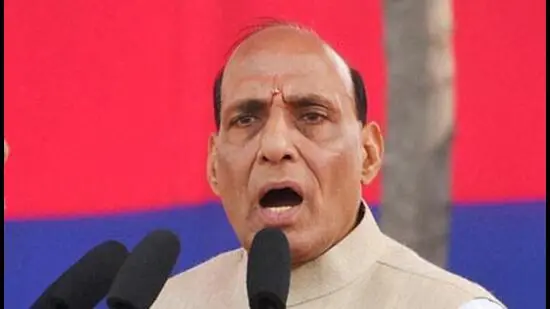
The Defence Acquisition Council (DAC), headed by Defence Minister Rajnath Singh, on Friday gave its go-ahead for the purchase of weapons and systems worth ₹52,000 crore to boost the armed forces’ capabilities.
The capability enhancement approved by the council, India’s apex defence procurement body, covers the procurement of a raft of systems, ranging from the anti-unmanned aerial vehicle (UAV) electronic warfare system AKASH TARANG and man-portable anti-tank guided missile (MPATGM) systems to the medium-range surface-to-air missile (MRSAM) weapon system, the defence ministry said.
The DAC also accorded its Acceptance of Necessity (AoN) for the procurement of the very short-range air defence system (V-SHORADS), an active protection system for tanks, and a jet-based kamikaze drone system, the ministry added in a statement.
The military hardware listed above is intended for the Army.
Under India’s defence procurement rules, AoN by the council is the first step towards acquiring military equipment. The DAC convened for the first time under India’s new military leadership—Chief of Defence Staff General NS Raja Subramani, Navy Chief Admiral Krishna Swaminathan, and Army Chief General Dheeraj Seth. The top appointments were made recently.
Also Read | India seeks Venezuela probe into missing organs of dead seafarer
Seth, who took over as Army chief on June 30, said on Wednesday that the force’s modernisation would form the bedrock of its transformation into a future-ready force.
What all warfare tools India will buy?
The defence ministry outlined the capability enhancement: AKASH TARANG will provide effective anti-UAV protection to Army formations; the MPATGM will enhance the infantry’s ability to counter the adversary’s mechanised threats; and the MRSAM system will provide medium-range air defence against various stand-off aerial threats.
“The V-SHORADS with multi-spectral sensing will enhance counter-measure resilience and effectiveness of the Indian Army. The active protection system will improve the defence mechanism of tanks and enhance their survivability. The jet-based kamikaze drones will provide better electronic warfare capability with greater lethality and survivability while also being cost effective,” the ministry said.
The military hardware approved for the Navy includes the multi-influence ground mine (MIGM), the naval shipborne unmanned aerial system (NSUAS), and the establishment of a land-based testing facility (LBTF) for electric propulsion systems.
“The MIGM will deny freedom of manoeuvre to the adversary. The NSUAS, equipped with advanced sensors, will enhance the Indian Navy’s situational awareness. The LBTF will meet the testing requirements for motors and associated propulsion systems of the Indian naval assets,” it said.
The Indian Air Force received approval to procure the fixed-wing-based high-altitude pseudo satellite (FW-HAPS). It will carry out intelligence, surveillance and reconnaissance (ISR), telecommunication, and remote sensing missions for the Air Force, the ministry added.
In February, India hiked its defence spending by more than 15% against the backdrop of Operation Sindoor, setting aside ₹7.85 lakh crore for the critical sector in the Union Budget for 2026–27.
This included a capital outlay of ₹2.19 lakh crore to boost the capabilities of the armed forces with new weapons and systems, including fighter aircraft, transport aircraft, helicopters, warships, submarines, artillery guns, smart weapons, missiles, rockets, and a variety of unmanned systems.