



We check the time hundreds of times a day, but how many of us know what the numbers actually mean? Where did the time on the clock come from?
There is no one specific civilization or time period that is solely responsible for the time measurements that we use today. Our clocks and watches are the accumulation of ideas from Egyptians, Sumerians, Babylonians and Greek astronomers.
Why 24 hours?
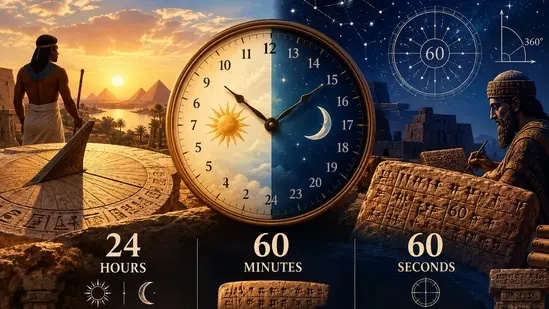
The secret behind our 24-hour day lies in the history of ancient Egypt. The Egyptians divided the day into 12 daylight hours and 12 hours of night, but their hours were not the same length as modern hours. Days were measured using a sundial and shadow clocks, while the night was measured using the appearance of constellations or decans.
It was the Greeks who came up with the idea of the 24-hour day. They proposed dividing the day into 24 equal parts or hours. Greek astronomer Hipparchus suggested using equinoctial hours (a division of the day based on equal-length hours) and this became the basis of the modern 24-hour day. Equal hours were not in common use in Greece, but they were brought back to Europe in the Middle Ages with the invention of mechanical clocks.
Why 60 minutes?
Looking back to another ancient civilization, the Sumerians and Babylonians, the reason why there are 60 minutes in an hour becomes clear. The Babylonians liked fractions and they used a sexagesimal (base 60) system, which is why we have 60 minutes in an hour and 60 seconds in a minute. Not only is 60 a highly composite number (it is divisible by 1, 2, 3, 4, 5, 6, 10, 12, 15, 20, 30 and 60), but this number was connected to a complete cycle of angles (360 degrees).
The influence of the sexagesimal system was so significant that it even shaped how we measure angles. Greek astronomer Claudius Ptolemy wrote a work in the 2nd century that further added to the popularity of the sexagesimal system. He divided every degree into 60 minutes and every minute into 60 seconds. This became the basis of the modern system of measurements.
It took centuries for these calculations to reach Europe, but eventually they became the basis for the system that we call modern times. Of course, our minutes and seconds have been measured with much greater precision than the Babylonians could have ever imagined. Since 1967 the SI second has been defined as the duration of 9,192,631,770 oscillations of the radiation associated with the transition between two energy levels of a caesium-133 atom.
So next time you look at your watch, remember that every hour, minute and second has quite an interesting past. The history of time is the history of mathematics and astronomy, dating back to ancient civilizations and their observations of sundials and constellations.
Sources
https://www.scientificamerican.com/article/experts-time-division-days-hours-minutes
https://www.nist.gov/pml/time-and-frequency-division/timekeeping-and-clocks-faqs
https://www.metmuseum.org/fr/essays/telling-time-in-ancient-egypt
https://www.nist.gov/si-redefinition/second-introduction
https://www.scientificamerican.com/article/experts-time-division-days-hours-minutes
https://www.livescience.com/44964-why-60-minutes-in-an-hour.html