



The race to leadership in artificial intelligence (AI) is usually discussed as a contest of algorithms, but that misses two other components — data, which trains the models; and compute, the physical machinery that turns both into working systems. Compute is both a matter of raw silicon power of chip infrastructure, but also increasingly of electricity to keep the chips running.
Meanwhile, the discussion around India’s role in AI has focused largely on whether it should build the algorithmic capabilities, where it currently lags behind the US and China. On data, India’s advantage is often overestimated: Value lies not in raw data alone but in having it categorised and tagged in a usable format, which remains a challenge in India. But on the third component of compute, there is an opportunity to catch up. Although India does not manufacture any of the world’s leading AI chips, and hosts only a small fraction of global compute capacity, its advantage may lie in the power needed to run the compute. India’s assessed solar potential, put at 748GW by the government in 2014, was revised upward in 2025 by the National Institute of Solar Energy, working with the space agency ISRO, to more than 3,300GW of ground-mounted capacity alone.
The Energy and Resources Institute (TERI) estimates that the total capacity, rooftop, floating, and other non-traditional applications, is just over 10,800GW. Fortunately, this capacity overlaps with the technology corridors of Bengaluru, Hyderabad, Chennai and Pune, cities where the future of AI will be built in India. In comparison, the regions with the most compute capacity in the US and China, including Northern Virginia, the Pacific Northwest, and the industrial belts of eastern China, do not have strong solar potential. Moreover, there is a growing backlash to AI data centers in the US where they are seen as increasing electricity rates, but not contributing to rural America in any significant way. In fact, there are accusations that this opposition to US data centers is being pushed by China as a way of decreasing US capabilities in compute.
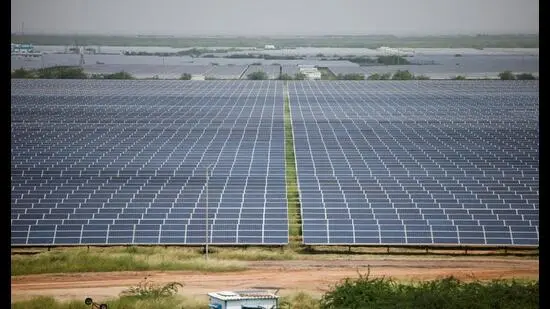
India has plentiful solar potential, and it is already putting it to use: installed solar capacity crossed 162GW by the middle of 2026, making it the world’s third-largest solar market and one of the fastest-growing. But that is not sufficient since the sun shines only during the day. The total installed battery storage in India was just under 6 gigawatt-hours (GWh) in early 2026, and far less than the roughly 160 to 240GWh that the grid is expected to need by 2030. In the most recent quarter of 2026, grid operators were forced to curtail more than 8,000 GWh of solar power simply because there was insufficient storage capacity for the energy generated. That is roughly the equivalent of overflowing India’s entire existing battery storage capacity 1,400 times over, in a single quarter.
Investing in energy storage at scale — batteries, pumped hydro, compressed air, or other emerging technologies — could turn India’s daytime solar glut into a continuous baseload for AI data centers.
Water consumption is often raised as a concern against data centers, but evidence suggests that this concern may be hugely overstated. Google estimated that a typical query of its Gemini models consumes only about 0.24 milliliters, equivalent to five drops of water, orders of magnitude below earlier independent estimates, some of which put water use as high as 50 milliliters per query. OpenAI estimates a comparable figure for ChatGPT. These efficiencies are enabled by closed-loop cooling, which works much like a large air-conditioning system, and direct-to-chip liquid cooling. There is also a shift toward reclaimed and non-potable water. Although the water needed per unit of computing is falling fairly quickly, total water consumption is still likely to increase because AI use is growing faster than the efficiency gains. Independent estimates now put global data center water use at 4.5 trillion liters in 2025, projected to rise to 9.3 trillion liters annually by 2030. This is enough to meet the basic domestic water needs of everyone in Sub-Saharan Africa for a year.
This risk is manageable in India, provided it is part of the initial planning because the tech corridors of Chennai and Bengaluru are also among its most water-stressed cities. If data centers are to pre-empt opposition from local communities, it is important to plan for new water capacity based on reclaimed or non-potable water and closed-loop cooling. This planning should be done at the design stage itself.
Noise is a less-discussed environmental problem associated with data centers and is the reason why residents living near them in US states like Virginia, Michigan, Wisconsin, and New Jersey are fighting them. They have described a constant mechanical hum from cooling equipment and backup generators that run day and night, and several resident groups have sued or forced projects to be scaled back. Experts I spoke to say that this is a solvable problem, provided it is designed for before construction, with buffer zones and acoustic engineering built into the design.
If India is to claim a share of the AI race, data centers are likely to be the first foray in. But this should be preceded by a clear set of easy-to-follow rules that address the issue of energy use (to ensure that the cost is not borne by other electricity users), investment in solar capacity and energy storage, provisioning for water consumption, and rules on noise. If this is done expeditiously, the regulatory clarity can bring foreign direct investment into India’s data center business, which can then become a serious node in global AI infrastructure.
India’s future in generative AI may be to focus on its strengths, which include data – although this is not yet curated at a level that is usable by AI, and also on the infrastructure that the world’s AI models will depend on. The future leaders in this space are not those who write the best code, but those who are able to convert electricity into intelligence in a sustainable way.
Ramanan Laxminarayan is president, One Health Trust. The views expressed are personal
(This is a Hindustan Times digital exclusive)