



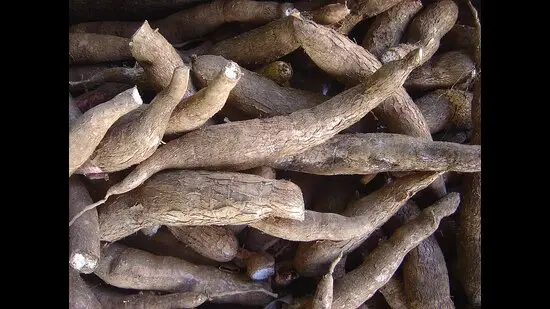
In November 1900, an interesting exchange of letters debating the protection of India from famines was published in the “Agricultural Ledger”. These letters were written by two men with very different ideas, and their subject was a root vegetable called cassava.
It started when Robert Thomson, an experienced tropical planter, reached out to Dr George Watt, the Scottish botanist and the author of “The Dictionary of Economic Products of India”. Thomson urged the government to introduce several varieties of cassava from Colombia to India, arguing that if it were grown instead of or alongside rice, it could completely wipe out the threat of famine.
Thomson believed that rice was a thirsty crop that needed 50 to 60 inches of rain a year to survive. Colombian cassava, on the other hand, could thrive on a mere 14 to 16 inches of annual rainfall and handle droughts lasting over six months at a time. Some varieties flourished in rich soil, while others did not mind poor, depleted dirt. He regarded it as an ideal famine crop.
Watt, however, was highly sceptical. He admitted he had very little faith in the idea of bringing in foreign plants, pointing out that less than one per cent of such experiments in India had ever actually worked. In his view, it was much wiser and more satisfying to focus on improving the crops India already had through careful local selection.
But Thomson reminded Watt that while Indians had mostly known cassava as the source of tapioca in recent years, Colombians had been cultivating and perfecting these specific varieties for generations. Trying to breed entirely new, drought-resistant varieties from scratch in India would take decades, Thomson argued, whereas India could import a score of proven, valuable varieties from Colombia right away. He was confident they would adapt successfully to Indian conditions.
Ultimately, Watt had the last word. He concluded that within a few years of arriving in India, all those unique Colombian varieties would probably blend down into just two or three types, looking no different from the local cassava plants already growing there.
This was not the first time that the topic of cassava cultivation had been discussed in the public domain. At the annual meeting of the Agricultural and Horticultural Society of Western India, held on February 25, 1839, Dr Beddle, a member, presented two specimens of cassava flour made from the cassava root grown in his garden in Bombay. He delivered a lecture on the methods of preparing the flour and cultivation of the plant. The members of the Society sent a letter to the government a month later stating that introducing cassava would be of great advantage to the country, which was often struck by famines.
Cassava, also known as manioc or yuca, is a woody shrub prized for its starchy, calorie-rich root tubers. It originally comes from South America, with its domestication tracing back nearly 10,000 years to the southern regions of the Brazilian Amazon.
The introduction of cassava to the Old World resulted in caloric and nutritional improvements over previously existing staples. European explorers first encountered cassava in the Americas during the 1500s. Spanish and Portuguese sailors relied on it as a sturdy bread to survive long ocean voyages. The Portuguese eventually introduced the resilient crop to the Malabar Coast of India in the 1600s.
By the 1860s, cassava was pretty common in Bombay gardens, but simply as an ornamental shrub. According to John Graham, the author of “A Catalogue of the Plants Growing in Bombay and its Vicinity” (1839), the natives did not seem to be aware of its uses, and if they were, could only be driven to them by a scarcity of their “common and inferior articles of food, afforded by the Cucumber and Arum tribes”.
In Poona, it was planted in the Dapoori Garden in 1841. A year later, Dr Alexander Gibson, superintendent, considered the cultivation of cassava “unsuited” to Poona.
Cassava was already extensively cultivated in Cochin, Travancore, Cuddalore, Pondicherry, and several other parts of southern India when the devastating famine of 1896–99 ravaged the Bombay Presidency.
Thomson and others sent petitions to the government for the cultivation of cassava. The government agreed.
A Bombay newspaper in its editorial on March 5, 1900, while praising the government for establishing experimental farms all over the country, mentioned the cultivation of cassava as an example of the “paternal anxiety” of colonial rulers towards the native subjects.
Experiments on a small scale began on various government stations in 1902, chiefly to ascertain whether cassava cultivation could be more widely extended. These experiments included comparative trials with the best varieties, both naturalised and imported, to determine the most suitable variety as regards outturn, yield of starch, and drought-resisting qualities.
The experiments on the Poona and Manjri farms were the most successful in India. In all, sixteen varieties were imported to Poona from places like Colombia, Jamaica, and Montserrat and were extended to other districts in the Presidency. The average outturn of tubers per acre on the Manjri farm was 16,248 lbs, the largest in India. The cultivation required very little effort.
However, the report of the agricultural department of Bombay for 1908–1909 mentioned that experiments tended to show that cassava’s efficacy as a drought-resister and famine food had been somewhat overrated and at none of the places did it give any promise of doing well. Although no difficulty was experienced in growing the sets, the outturn per acre was too small to make its cultivation profitable.
While agricultural departments of various provinces appeared to have different policies regarding cassava cultivation, in Poona, it was actively studied at the Poona experimental farm until the 1920s. It had then been growing there satisfactorily for years, but had never been taken up by the cultivators in the Presidency, and the department actively encouraged farmers from Poona to undertake the cultivation. The department told the farmers that they would yield a good income since some Hindus had started consuming cassava meal and tapioca during fasts.
Cassava was eaten in several forms. Couac was the coarsest, roughest meal, while cassava meal was a finer preparation. Brazilian arrowroot was starch washed out of the root, and tapioca was the same, lightly torrefied. The farmers were unsure of the commercial viability.
According to a Bombay newspaper (March 13, 1921), the agricultural department of the Bombay Presidency had failed to convince the farmers to cultivate cassava because there were no consumers.
But several organisations, like The Bombay Chamber of Commerce, kept approaching the government to intensify its drive for cassava cultivation.
Governments and experts often believed that a new crop, superior seed, or improved method could avert future crises. However, success depended on more than drought resistance; farmers had to grow it, consumers had to eat it, and markets had to exist. For all the enthusiasm among officials, cassava remained largely experimental in the Bombay Presidency. The root hoped to banish famine ultimately found few takers, leaving behind a paper trail that reveals both the ambitions and limits of colonial agricultural science.