



It is early March, the afternoons are already hot. If humankind had never invented electricity—no air-conditioners, no coolers—the good old way to escape the hostile weather would have been to move downward into this curious structure, step by step, toward the receding water below. There, the breeze rises directly from the surface, cooler and cleaner, in shade and shantih.
This is the baoli—the old stone stepwell. A monument to summer.
One of Delhi’s most intriguing and lesser-known baolis stands beside the Sufi shrine of Hazrat Khwaja Qutbuddin Bakhtiar Kaki in Mehrauli. This afternoon, the Qutub Saheb ki Baoli is covered by a metal grid. While its massive stone walls are lined with deep niches, as if the well’s sides were designed for small gatherings waiting out the heat. The well is believed to be built centuries ago by Sultan Iltutmish, whose grave lies within the nearby compound of the world-famous Qutub Minar.
Stepwells were built wherever water was scarce. Through the long summers, they offered refuge. When the heat became unbearable, citizens withdrew into the lower chambers of a baoli and lingered in the dim coolness near the water.
Mehrauli, among Delhi’s oldest inhabited quarters, holds at least three such wells. The oldest surviving is the 13th-century Gandhak Ki Baoli. Its name comes from the sulphur once present in its water, believed to cure skin ailments. A short distance away stands Rajon Ki Baoli. It is the grandest of the three: a descending staircase framed by rows of arched niches. Yet, it is the baoli beside the dargah that feels the most intimate. The metal net that covers it may seem frustrating, but that has become the baoli’s saviour. The well used to be choked with litter. The barrier has given it a measure of protection.
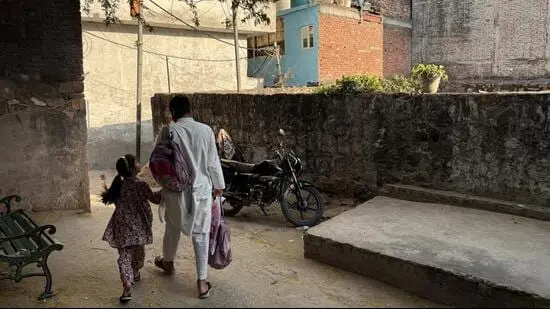
While you cannot see much of the structure due to the metal net, it is the only baoli in the city that feels fully absorbed into neighbourhood life. (Almost all the other baolis often stand deserted.) This afternoon, the mohalla lane that gently curves by the baoli is exuding a lived-in warmth. A bench stands in one corner. Nearby, a man in a white kurta-pyjama is sitting beside a chai stall. Two boys, barefoot, are leaning over their mobile phones on a wooden cot; their shoes lying beneath. Now two goats wander past; one pauses by the wooden cot, and puts her hoof into a shoe.
Soon one more citizen appears, holding hands with a child, a schoolbag on his shoulder. Both walk down the lane, skirting the wall along the baoli’s edge. See photo.
Indeed, for the people and animals here, the old stepwell is an integral part of their landscape—like the grey sky above the lane. This deep hollow in the ground might be older than many of the city’s graveyards, but it nevertheless strives to be a part of the current era, quietly being a companion to the everyday life of the vicinity’s small hyperlocal universe.