



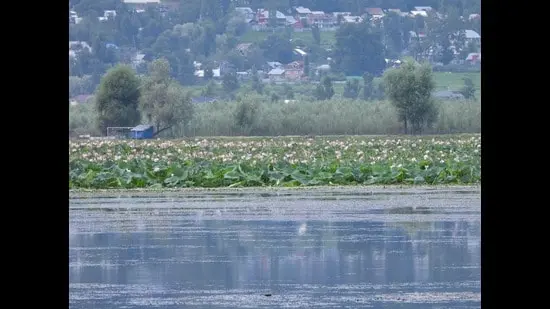
To revive the ecological health of Wular Lake—a Ramsar site and Asia’s second-largest freshwater lake—authorities have successfully cleared silt from a 5-km stretch and removed 1.31 lakh willow trees.
Officials said that nearly 78.43 lakh cubic metres of silt have been dredged to reclaim the lake area and enhance water-holding capacity. “Protection bunds have been strengthened along about 15 km of vulnerable stretches to prevent encroachments and provide flood buffering,” an official of the Wular Conservation and Management Authority said.
He said the eco-restoration drive is supported by infrastructure development, including a 2.5-km non-motorable walkway at Banyari–SK Payeen featuring cycling tracks and viewing points, along with the development of parks at multiple locations to promote eco-tourism.
The official said the boundary demarcation of the lake has been completed by installing 1,159 geo-referenced RCC pillars using GPS and remote sensing technology.
“Desiltation has restored 5 sq km of critically silted lake area by dredging 78.43 lakh cubic metres of silt, enhancing the lake’s water-holding capacity. Bund consolidation has been undertaken by strengthening earthen embankments along 15 km of vulnerable stretches to prevent encroachments and provide flood buffering to the local communities residing around the Wular Lake,” the officials said.
He said the construction of the non-motorable walkway Phase-II is in process and expected to start soon.
“The upgradation of Delta Park, Baniyari, at a cost of ₹2.50 crore, Gurura Park at ₹4.70 crore, and the construction of Eco-Park at Ningli, Sopore at a cost of ₹4.90 crore, are under execution.Two watch towers equipped with CCTV cameras have been constructed, while four additional CCTVs are being installed this year,” the official said.
He said the number of willow trees in and around Wular Lake is 19-21 lakh.
“In the first phase, 1.91 lakh willow trees were identified for removal, of which around 1.35 lakh have already been cleared. Revenue generated from these interventions stands at approximately ₹31.95 crore,” officials said.
The shallow lake with a maximum depth of 5.8 metres covers 130 sq km and is spread over two districts of North Kashmir, Baramulla and Bandipora, and provides 60% of the Valley’s fish produce and is home to lakhs of local and migratory bird species. Known for water chestnuts and lotus stems, the lake is the lifeline of the 30 villages surrounding it. It was designated as a wetland of international importance under the Ramsar Convention in 1990.
Over the past three decades, the Wular has been losing its carrying capacity due to plantation and encroachment. The water quality deteriorated after untreated sewage and solid waste was disposed of in it, while the inlet and outlet channels were blocked and forest degradation in the catchment areas added to the problem.
Work in progress on fast pace since 2020
Wucma was set up for the lake’s conservation in September 2012 but it’s only since May 2020 that work picked up pace. A sum of ₹200 crore has already been spent under the UT’s fund for developing ecotourism in the first phase, while the total tentative cost of the project is ₹1,600 crore.
In 2018, the UT administration had sanctioned the ₹200-crore Wular Action Plan for the conservation and management of the lake, phase one has almost reached completion, which has increased the capacity of the lake.
Officials say that around ₹1,600 crore will be needed to clear 27 sq km of the critically silted lake. The government also plans to construct a big foreshore around the lake with parks, bird watching towers and guest houses to attract tourists in the area.
Besides land and water resource management, the authority is working for biodiversity conservation, eco tourism, construction of a shoreline around the lake, recreational parks, bird watching points and developing the Wular Boulevard.