


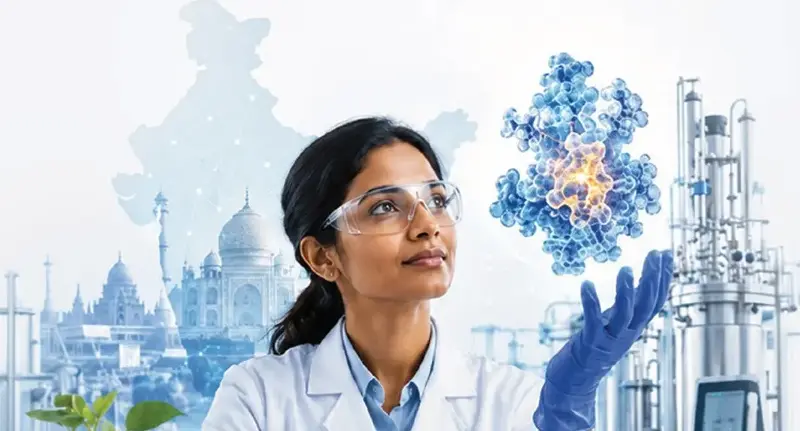
India, July 1 -- image credit- freepik
India's pharmaceutical industry, already the world's third largest by volume, is undergoing a transformative shift driven by enzymatic technology. For the last few decades, enzymes have played an important but mostly behind-the-scenes role in pharmaceutical manufacturing. Today, however, industrial enzymes are evolving from auxiliary manufacturing aids to critical components enabling sustainable, cost-efficient drug production, moving from process enablers to strategic innovation drivers.
"This is in line with the global shift towards greener chemistry, complex therapeutic molecules, and cost-efficient production processes, which are accelerating the adoption of enzyme-based technologies. The question therefore is no longer whether enzymes will become more important to the industry, but how quickly India can position itself at the forefront of enzyme innovation," said Prashant Nagre, Managing Director, Fermenta Biotech.
Fermenta is one of India's leading enzyme manufacturers, offering a diverse portfolio of enzymes for pharmaceutical, nutraceutical, and industrial applications. The company approved a capital expenditure of Rs 110 crore in December 2025 to expand its manufacturing facility at Dahej, Gujarat.
The growing adoption of biocatalysis is delivering measurable benefits for pharmaceutical manufacturers. Enzyme-based manufacturing routes can reduce the number of process steps by 20-50 per cent while improving yields, lowering solvent consumption, and significantly reducing waste generation. Enzymes also offer exceptionally high stereoselectivity, often exceeding 99 per cent, making them particularly valuable for the production of complex chiral APIs where purity and efficiency are critical.
One of the most widely cited examples of the power of industrial biocatalysis comes from Merck's manufacturing process for sitagliptin, a blockbuster diabetes drug. The company replaced a conventional chemical synthesis step with an engineered transaminase enzyme, resulting in a yield improvement of approximately 10-13 per cent while substantially reducing waste generation. The enzymatic route also eliminated the need for expensive rhodium-based catalysts, demonstrating how enzyme engineering can simultaneously improve process economics, sustainability, and product quality. Today, the sitagliptin case is regarded as a landmark example of how customised enzymes can transform pharmaceutical manufacturing.
Enzymes Across the Pharma Value Chain
Around 200 of the nearly 4,000 known enzymes are currently used for commercial applications worldwide. The global enzyme industry remains highly concentrated, with nearly 75 per cent of total enzyme production accounted for by three major players: Denmark-based Novozymes, US-based DuPont, and Switzerland-based Roche, according to Biotechnology and Applied Biochemistry Journal.
India, meanwhile, has developed a sizable enzyme ecosystem, with well over 100 companies involved in enzyme manufacturing, formulation, distribution, and supply. As of May 2026, Enzyme Directory, an industry directory alone listed 131 enzyme suppliers operating in the country. However, the domestic market is also relatively concentrated, with the top three companies accounting for 66.4 per cent of the total industrial biotechnology (enzyme) market. These include Novonesis (formerly Novozymes), Advanced Enzyme Technologies Limited, and Lumis Biotech Pvt Ltd, according to Indextb.
According to Grand View Research, India's enzymes market was valued at $ 440.5 million in 2023 and is expected to grow at a CAGR of 7.8 per cent from 2024 to 2030, driven by rising demand from pharmaceutical, biotechnology, food, and industrial applications.
Several enzyme classes are widely used across pharmaceutical manufacturing, including transaminases, lipases, proteases, penicillin acylases, ketoreductases, nitrilases, oxidoreductases, and glycosyltransferases. India has established a strong manufacturing base for conventional enzymes such as lipases and proteases, with companies including Advanced Enzyme Technologies, Maps Enzymes, Biolaxi, Syngenic Bioscience, Lumis Biotech, and Rossari Biotech serving the market. However, production of advanced pharmaceutical biocatalysts such as ketoreductases, glycosyltransferases, alcohol dehydrogenases, and oxidoreductases remains limited, with much of the demand still being met through imports.
Although enzymes are used across various stages of drug development and manufacturing, where they play a critical role in improving process efficiency, product quality, and sustainability, which process has seen the highest demand?
"The highest demand for industrial enzymes comes mainly from APIs where enzymes such as Penicillin G Acylase are critical to produce semi-synthetic antibiotics. This segment drives the greatest volume of demand and is of strategic importance to India's pharmaceutical exports," said Nagre.
He added, "Enzymes are also gaining relevance in the synthesis of API intermediates, where they enable more selective reactions, improved yields, fewer processing steps, and reduced dependence on harsh chemical routes. This makes them especially valuable for manufacturers seeking cleaner, more efficient, and globally compliant production processes."
Beyond APIs, enzymes are increasingly being explored in adjacent industrial domains such as environment solutions and oleochemicals. In environmental applications, enzyme-based processes can support cleaner effluent treatment, biodegradation, waste valorisation, and reduction of chemical load in industrial operations. In oleochemicals, enzymes such as lipases can enable more sustainable transformations of oils and fats into high-value ingredients, intermediates, and specialty chemicals. These applications reflect the broader role of enzymes in helping industries transition from conventional chemistry to greener, bio-based manufacturing platforms.
"Growth is also being fueled by the expanding biologics ecosystem, including peptides, recombinant proteins, and next-generation therapeutics that rely on sophisticated biological manufacturing processes. Enzymes are essential for protein modification, cell culture processes, and purification steps in the manufacturing of high-value biologic drugs. The complexity and premium pricing of biologics make enzyme quality critical," said Nagre.
The CDMOs are emerging as a significant driver, as they serve global clients and require enzymatic technologies that meet international regulatory standards for sustainability, quality, and process efficiency. "Drug discovery is another important area where enzymes enable faster and more selective synthesis of novel compounds, accelerating early-stage drug development. While these applications are smaller in volume, they represent high-value opportunities," added Nagre.
The Rise of Customised Enzymes
Enzymes used in pharmaceutical and industrial applications are derived from a variety of biological sources, including microorganisms, plants, and animals. Papain, for instance, is extracted from papaya, while bromelain is obtained from pineapple. Many commercially important enzymes, such as amylases, are produced through microbial fermentation using carefully selected bacterial or fungal strains.
"Today, manufacturers increasingly rely on GRAS-recognised, non-GMO microbial strains for fermentation-based production. These microorganisms are cultivated under controlled conditions, after which the enzymes are harvested, purified, and formulated for specific industrial applications." Yatinkumar Wani, Director, Biolaxi Corporation.
One of the leading players in the enzyme space, Biolaxi Corporation is expanding its manufacturing capabilities to meet growing market demand. The company is currently scaling up operations and investing in larger fermentation facilities with capacities of up to 100 KL, strengthening its ability to serve the pharmaceutical, nutraceutical, and industrial sectors.
However, the pharmaceutical industry's evolving needs are now reshaping the enzyme landscape. Experts note a clear and accelerating shift from standard, off-the-shelf industrial enzymes towards customised and engineered enzymes designed for specific pharmaceutical applications. While conventional enzymes continue to support many established manufacturing processes, the growing complexity of modern drug molecules is creating demand for more specialised biocatalytic solutions.
According to Nagre, several factors are driving this transition.
Customisation: Pharmaceutical companies are developing increasingly sophisticated molecules that require highly selective transformations that off-the-shelf enzymes cannot deliver. Standard enzymes may not always provide the desired activity, stability, or specificity needed for these processes. Advances in protein engineering, synthetic biology, and computational modelling now allow scientists to design enzymes with enhanced performance characteristics tailored to specific substrates and reaction conditions. Customised enzymes offer:
Sustainability: It has become a key consideration across the pharmaceutical sector. Engineered enzymes enable reactions to be carried out under milder temperatures and pressures while also reducing solvent consumption, waste generation, and energy requirements. This helps the industry's growing commitment to green chemistry and environmentally responsible manufacturing.
Environmental regulations and corporate sustainability goals drive demand for engineered enzymes that:
Demanding Regulatory and Quality Standards: Global markets (US, EU) demand pharmaceuticals manufactured under stringent quality standards. Customised enzymes provide:
Cost Optimisation and Time to Market : The need for greater process efficiency and faster time-to-market is moving pharmaceutical companies to adopt customised biocatalytic solutions that can improve yields and help streamline manufacturing workflows. Customised enzymes, even though more expensive initially, deliver superior economics through:
Intellectual Differentiation: Pharmaceutical companies seeking competitive advantage use engineered enzymes for:
This shift is fostering closer collaboration and partnerships between enzyme developers and pharmaceutical manufacturers, creating integrated innovation ecosystems.
Can India Become a Global Enzyme Innovation Hub?
India manufactures large volumes of conventional industrial enzymes such as lipases, proteases, and amylases, but remains dependent on imported high-performance pharmaceutical biocatalysts such as transaminases, ketoreductases, glycosyltransferases, and engineered enzymes used in advanced API synthesis.
"Industry estimates suggest that nearly 70-80 per cent of enzymes used in India are currently imported, primarily from Europe and China. One of the reasons for this dependence is the technological complexity associated with enzyme production. Fermentation-based manufacturing carries significant operational risks. Even minor contamination can lead to complete batch failure, resulting in substantial financial losses. As a result, many companies prefer to source enzymes from established international suppliers rather than invest in domestic manufacturing capabilities," said Wani.
However, experts believe this situation also presents a significant opportunity. "Companies that can successfully develop proprietary strains, scale up fermentation processes, and manufacture specialised enzymes domestically stand to benefit from a rapidly expanding market. Advanced enzyme products imported today are often highly engineered, application-specific, and designed to deliver enhanced performance and efficiency for end users. If such capabilities can be developed within India, the growth potential is enormous," said Wani.
Industry stakeholders believe the next phase of growth will depend heavily on advances in biotechnology. "To become a global leader in enzyme innovation, however, the country must strengthen its capabilities in advanced biotechnology, enzyme engineering, and translational research," said Nagre.
Wani agrees, "Emerging technologies for strain development, microbial engineering, and process optimisation are enabling manufacturers to produce enzymes with greater specificity and performance. The ability to create strains tailored for particular industrial requirements could significantly improve productivity and commercial viability."
Government support is also beginning to strengthen the ecosystem. In August 2024, the Government of India approved the BioE3 (Biotechnology for Economy, Environment and Employment) Policy to promote high-performance biomanufacturing and position India as a global bioeconomy leader. Bio-based chemicals and enzymes are among the six priority sectors identified under the policy.
However, industry experts believe that policy support alone will not be sufficient. Significant gaps remain if India is to emerge as a global enzyme innovation leader. "One of the most important requirements is increased investment in research and development. Leadership in enzyme innovation will depend on capabilities such as protein engineering, synthetic biology, computational enzyme design, metabolic engineering, and advanced fermentation technologies," said Nagre.
Another critical factor is fostering stronger collaboration between academia, research institutions, biotechnology companies, and pharmaceutical manufacturers. Globally, successful innovation ecosystems are characterised by close partnerships that accelerate the journey from laboratory discovery to industrial application. Creating more industry-academia collaboration platforms can help bridge this gap.
Talent development is equally important. Future enzyme innovation will require multidisciplinary expertise spanning biology, chemistry, data science, artificial intelligence, and process engineering. Building this talent pool will be essential for long-term competitiveness.
"From an industry perspective, greater investment in pilot-scale infrastructure, technology transfer capabilities, and commercialisation pathways is also needed. Underlying all of this, supportive government policies and innovation-focused funding programmes can further accelerate progress," said Nagre and further added "Government policy support through the self-reliance (Atmanirbhar Bharat) initiative should include tax incentives for enzyme R&D investment, grants for enzyme technology startups, and strong intellectual property protection for enzyme engineering innovations".
India's emergence as a global pharmaceutical manufacturing leader has been built on strong process chemistry capabilities, cost-efficient production, and large-scale manufacturing expertise. The country has firmly established itself as a pharmaceutical powerhouse, being the world's largest vaccine producer by volume, the third-largest pharmaceutical producer by volume, and a leading supplier of generic medicines and antibiotics. To become a global leader in enzyme innovation, however, India must now complement its manufacturing strengths with deeper capabilities in advanced biotechnology, enzyme engineering, and translational research.
Ayesha Siddiqui