


Humanoid robots, quantum computing, satellites and neurotechnology are moving towards wider commercial use, offering Thailand opportunities to raise factory productivity, advance healthcare and develop space services, according to executives of leading technology companies.
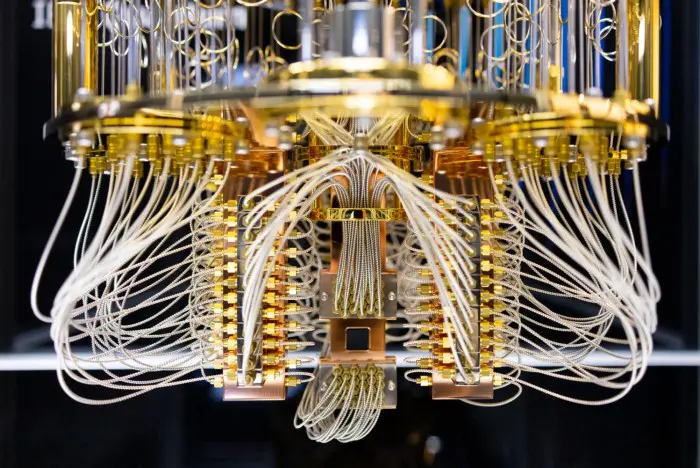
Quantum computing is converging with artificial intelligence (AI) and hybrid cloud, opening opportunities to tackle problems beyond the practical capabilities of conventional computers, Anothai Wettayakorn, country manager of IBM Thailand, said at the recent CP Innovation Exposition 2026.
IBM's quantum advantage programme aims to demonstrate useful, verifiable calculations beyond the practical capabilities of classical supercomputers. Potential applications include molecular simulation, materials discovery, drug development and cancer vaccine research.
A quantum advantage occurs when a quantum computer performs a computation beyond what classical computing can achieve alone, according to IBM.
Chiang Mai University has joined the IBM Quantum Network through the IBM Quantum Innovation Center at the National University of Singapore. Quantum Club Thailand, supported by True Corporation and other partners, aims to develop local talent, research and industrial applications.
A planned milestone is IBM Quantum Starling, a fault-tolerant quantum computer set for unveiling in 2029 and designed to run circuits containing up to 100 million quantum gates on 200 logical qubits.
ROBOT DEPLOYMENT
Kun Huang, vice-president for Asia Pacific and the Middle East at Agibot, said humanoid robots are moving from development to deployment, with industrial productivity the priority.
"We are moving from the development phase to the deployment phase to deliver real productivity in industrial plants," he said.
Agibot offers full-size humanoids, smaller robots, wheeled platforms and tracked machines for different operating environments. The company's G2 humanoid and wheeled models work on production lines at a major electronics original design manufacturer, while automotive deployments support material handling and logistics.
The company's robots have been deployed across more than 300 theme parks, cultural sites and retail brands in China.
Agibot is developing capabilities in movement, object handling and interaction to help robots operate in real-world environments and communicate with people.
Over a three-year period, the company plans to expand across industries. In Thailand, it is working with partners including Charoen Pokphand Group to promote robot adoption in manufacturing, healthcare and services. Material handling, goods sorting and customer service offer potential starting points, with robot capabilities matched to specific tasks.
Peter Huang, international vice-president of Galaxy Space, said satellite services are expanding beyond broadband to combine communications, Earth observation and computing.
The company has launched more than 50 satellites, including over 10 radar satellites, and provides broadband to remote areas, ships and aircraft.
Galaxy Space's radar satellites support agriculture and disaster management by monitoring conditions day and night, even through clouds and rain. This year it successfully tested direct-to-cell technology, enabling standard smartphones to connect directly to satellites without hardware modifications.
Over the next three years, the company aims to integrate communications, sensing and onboard computing for real-time monitoring and data sharing. Satellites are also expected to become part of future 6G infrastructure.
In Thailand, Galaxy Space partnered with True Innovation Center and Mahanakorn University of Technology to develop engineers and local applications, including flood forecasting and wildfire monitoring.
"Thailand should move from being a buyer to becoming a provider of satellite solutions," he said.
NEUROTECH ADVANCES
Hualiang Ni, chief executive and founder of OYMotion, said advances in sensors, neural-signal processing, robotic prosthetic hands and exoskeletons are helping people regain physical function.
Applications include enabling amputees to control prosthetic limbs and supporting rehabilitation after strokes or neural injuries. A recent development combines AI models with wristband sensors to interpret movement intentions from nerve signals, extending control from basic hand gestures to individual finger movements.
The longer-term goal is to make neural-control devices intuitive and accessible enough for wider use, helping patients regain mobility, independence and the ability to work.
For Thailand, adoption in rehabilitation and assistive healthcare will depend on partnerships connecting technical capabilities with patient needs.
"This isn't just about technology; it's about giving patients back their physical independence and dignity," Mr Ni said.