


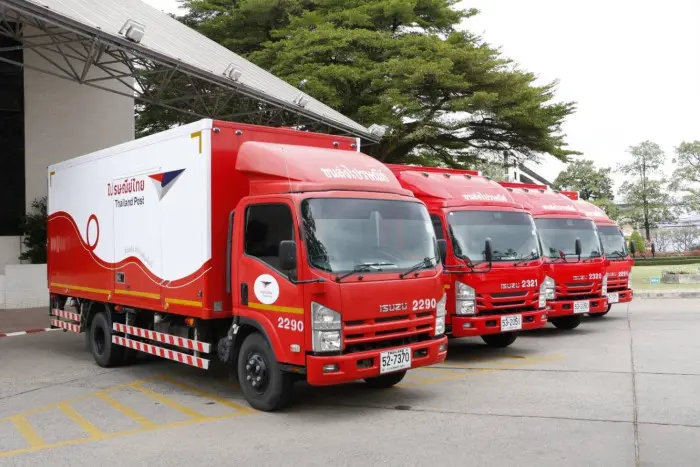
Thailand Post posted earnings before interest, taxes, depreciation and amortisation (Ebitda) of over 100 million baht during the first six months of this year, despite severe macroeconomic and operational headwinds.
The state enterprise has revised its business continuity plan (BCP) to establish standard operating procedures for different emergency scenarios, enabling it to respond more consistently to disruptions affecting its delivery network.
President and chief executive Dhanant Subhadrabandhu said the financial performance was underpinned by strong growth in the state enterprise's commercial operations, particularly in its express and e-commerce logistics businesses.
Thailand Post's overall express delivery revenue expanded by nearly 10% year-on-year, while its local e-commerce parcel volume jumped by 30% year-on-year.
This performance reflects enhanced brand trust, continuous service quality upgrades and successful market share expansion in the e-commerce segment, despite constrained consumer purchasing power, Mr Dhanant added.
Commercial logistics services now generate 47% of total revenue, strengthening the state enterprise's financial self-sustainability and offsetting the costs of loss-making public service obligations.
BCP OVERHAUL
Mr Dhanant said that Thailand Post is undertaking a full overhaul of its BCP to navigate severe external pressures, including fuel price spikes of 30–40%, cross-border flight disruptions and, more recently, widespread domestic flooding.
The revision shifts away from rigid, scenario-specific protocols towards a generic, highly flexible operational framework.
"This strategy enables rapid operational adaptation during complex and unprecedented emergencies, ensuring uninterrupted logistics and effective national support," Mr Dhanant said.
"During severe flooding, for example, parcels destined for inaccessible areas are kept safely at postal facilities. Customers are updated regularly until routes become accessible again."
Local employees may also be affected by the same disasters, adding to the complexity of maintaining services.
WORKFORCE RESTRUCTURING
Thailand Post has been preparing its first early retirement programme over the past three years, pending board approval, to address a high personnel cost structure that accounts for nearly 57% of total operating expenses, with state enterprise employee welfare representing 13% of total labour costs.
Mr Dhanant said the restructuring focuses on backend and support functions.
However, the changes are not intended to reduce the number of frontline postmen.
Mr Dhanant said that delivery personnel remained essential because staffing requirements were closely linked to geographic coverage across the country. Drones and autonomous delivery vehicles were not yet sufficiently practical for widespread deployment in Thailand to replace human delivery workers.
Instead, the company plans to improve productivity through automation, redesigned processes, and centralised shared-service units.
Job descriptions and organisational responsibilities are also being reviewed, particularly in back-office and support functions.
Thailand Post is seeking to increase the revenue contribution of commercial logistics and other market-based businesses while continuing to fulfil its public-service obligations.
Commercial logistics currently accounts for approximately 47% of total revenue, and this proportion is rising, according to Mr Dhanant.
The company is also developing new growth opportunities in digital services, retail and related commercial offerings to create additional sources of revenue, he said.
"With fuel costs elevated, cross-border flows disrupted and extreme weather posing continuing risks, the company's ability to combine operational discipline, digital expansion and organisational reform will be central to sustaining its financial performance," Mr Dhanant said.