


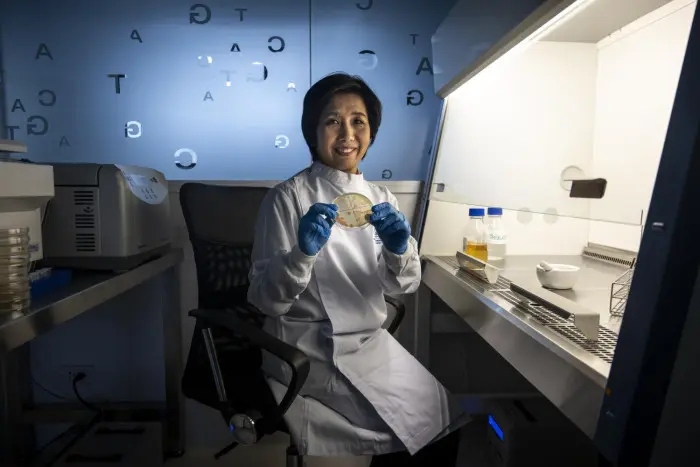
Thai scientists are preparing to send bacteria isolated from Thai corals to the International Space Station (ISS) for the first time, in a pioneering experiment to study how microorganisms adapt to extreme conditions and potentially improve coral reef conservation and restoration.
The samples, collected from coral reefs around Samae San Island in Chon Buri, are scheduled to be sent into space in the summer of 2027 under the L³: Little Living Lab research project, supported by the National Geographic Society.
The Thai research team, led by Prof Suchana Chavanich of Chulalongkorn University, will study bacteria from the genus Pseudoalteromonas to determine how they respond to microgravity and radiation in space.
Prof Suchana, deputy director of the university's Aquatic Resources Research Institute and a National Geographic Explorer, said corals did not live in isolation but shared their ecosystems with numerous microorganisms that influence their health and function. Understanding how these microbes respond to environmental stress could help researchers identify ways to strengthen coral resilience as climate change threatens marine ecosystems.
"Although coral reefs are large ecosystems, their future may depend on very small organisms, such as the microorganisms living alongside them," she said. "Studying how these microbes respond to extreme conditions may offer new perspectives on developing ways to improve coral resilience."
The experiment will examine bacterial growth, biofilm formation, pigment production and other biological changes associated with environmental stress. Researchers will compare the results with control samples kept on Earth to identify differences in the bacteria's responses.
The study will also explore whether any increased tolerance to harsh conditions could eventually help scientists develop approaches to coral restoration. However, the research aims to build scientific understanding rather than provide an immediate solution to reef degradation.
The L³ project brings together three National Geographic Explorers from Thailand, the United States and Zambia, each contributing microorganisms from different ecosystems for experiments aboard the space station. The planned experiment will run for about 50 days, combining marine science, microbiology and space technology.
For Thailand, the mission marks a significant step in bringing biological resources and scientific knowledge from local ecosystems into international space research. Prof Suchana said the ultimate goal was to apply knowledge gained in orbit to protect ecosystems on Earth. "If the knowledge gained from experiments in space helps us protect coral reef ecosystems more effectively, it will show that exploration beyond Earth can also help us care for our home planet."