


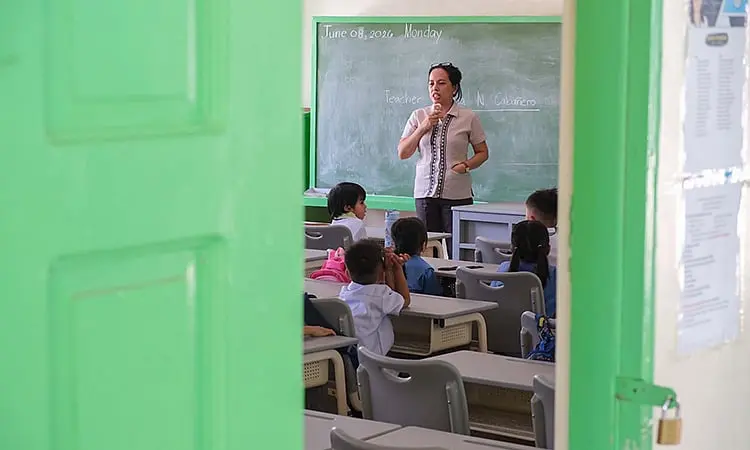
DepEd 7 announced on June 8, 2026, that Central Visayas schools are implementing double-shift schedules to manage a massive infrastructure shortage of 8,287 classrooms in Cebu and 1,713 in Bohol.
Infrastructure recovery remains severely delayed, with no new DepEd-funded classroom projects breaking ground six months into 2026 because the regional office is still waiting for Central Office project listings.
An electrical fire at Sudtonggan Elementary School on the first day of classes damaged a classroom ceiling and left seven adjacent rooms unusable, forcing affected students into remote blended learning.
SCHOOLS across Central Visayas are switching to double-shift schedules for School Year (SY) 2026–2027 to deal with a massive shortage of over 10,000 classrooms. Announced during a media briefing on Monday, June 8, 2026, this strategy aims to keep children in school while the region waits for new buildings and disaster repairs. The morning and afternoon shifts will help maximize resources in areas facing high enrollment and unsafe facilities.
Where the shortages are highest
The Department of Education (DepEd) 7 revealed that the region urgently needs thousands of learning spaces. Current data shows a major backlog of 8,287 classrooms in Cebu and 1,713 in Bohol.
According to Tomas Pastor, chief of the Education Support Services Division, natural disasters severely worsened this crisis. A magnitude 6.9 earthquake in northern Cebu and typhoon Tino in November 2025 left many school buildings completely unsafe to use.
“The schools that were affected by the earthquake, so far face-to-face classes are not yet fully implemented. Some are still shifting because there are buildings that have not been fully repaired,” Pastor explained.
Delays in building new classrooms
Fixing the classroom crisis has been slow. Six months into 2026, no new DepEd-funded classroom projects have broken ground in Central Visayas.
Former DepEd 7 director Salustiano Jimenez previously noted that the regional office is still waiting for the Central Office to release its priority project listings. To cope with the delays, schools are using Temporary Learning Spaces, while the Cebu Provincial Government plans to build temporary learning shelters.
First-day fire sparks safety concerns
The dangers of old or strained infrastructure became clear on Monday, the very first day of school. A fire broke out inside a Grade 3 classroom at Sudtonggan Elementary School in Barangay Basak, Lapu-Lapu City.
The fire started at 10:46 a.m. from a defective ceiling fan that was turned on by mistake. Principal Precious Vano said the teacher evacuated the students immediately and faculty members used a fire extinguisher to put out the flames by 10:50 a.m.
“We have teachers who are already trained and oriented on how to use fire extinguishers,” Vano said.
Investigator FO1 Vincent Rhey Reyes from the Lapu-Lapu City Fire District reported that the fire damaged 50 square meters of the ceiling. Fortunately, no students or staff were injured, but seven adjacent rooms are now unusable while safety investigations take place.
Blended learning to the rescue
To keep education going despite limited physical space, DepEd 7 is relying heavily on remote learning. Affected students in Lapu-Lapu City are currently getting their assignments and activities coordinated through digital group chats.
On a larger scale, DepEd 7 expects minimal disruption because students are already used to alternative learning methods. Regional Information Officer Amaryllis Villarmia explained that teachers are focusing on essential lessons so students can study from home.
“I don’t think it would be much of an adjustment for our students since we have been implementing blended learning since the Covid-19 period,” Villarmia said. “Even though they are not inside the classrooms, we have Alternative Delivery Modes that we use for students to learn something even in their houses.”
Securing funding to repair damaged facilities and build permanent classrooms remains the top priority for DepEd 7 as it navigates the infrastructure hurdles of the current school year. Balancing student safety with the urgent need for consistent education will be the region's biggest challenge in the months ahead. / APRIL VINCE VILLACORTA, JASMINE VERGANTIÑOS, ANDRIE CARTILLA, CNU INTERNS / DPC